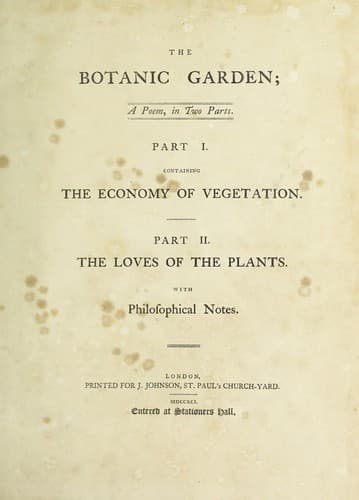
The Botanic Garden. Part 2, Containing the Loves of the Plants. A Poem.: With Philosophical Notes.Darwin, Erasmus
History
The Botanic Garden. Part 2, Containing the Loves of the Plants. A Poem.: With Philosophical Notes.
Darwin, Erasmus
Natural history; Plants -- Poetry
The difficulty of raising the Orchis from seed has, perhaps, been a
principal reason of its not being cultivated in this country as an
article of food. It is affirmed, by one of the Linnean school, in the
Amoenit. Academ. that the seeds of Orchis will ripen, if you destroy the
new bulb; and that Lily of the Valley, Convallaria, will produce many
more seeds, and ripen them, if the roots be crowded in a garden-pot, so
as to prevent them from producing many bulbs. Vol. VI. p. 120. It is
probable either of these methods may succeed with these and other
bulbous-rooted plants, as snowdrops, and might render their cultivation
profitable in this climate. The root of the asphodelus ramosus, branchy
asphodel, is used to feed swine in France; and starch is obtained from
the alstromeria licta. Memoires d'Agricult.]
135 O'er silent floods, white hills, and glittering meads
_Six_ rival swains the playful beauty leads,
Chides with her dulcet voice the tardy Spring,
Bids slumbering Zephyr stretch his folded wing,
Wakes the hoarse Cuckoo in his gloomy cave,
140 And calls the wondering Dormouse from his grave,
Bids the mute Redbreast cheer the budding grove,
And plaintive Ringdove tune her notes to love.
Spring! with thy own sweet smile, and tuneful tongue,
Delighted BELLIS calls her infant throng.
145 Each on his reed astride, the Cherub-train
Watch her kind looks, and circle o'er the plain;
Now with young wonder touch the siding snail,
Admire his eye-tipp'd horns, and painted mail;
Chase with quick step, and eager arms outspread,
150 The pausing Butterfly from mead to mead;
[_Bellis prolifera_ l. 144. Hen and chicken Daisy; in this beautiful
monster not only the impletion or doubling of the petals takes place, as
described in the note on Alcea; but a numerous circlet of less flowers on
peduncles, or footstalks, rise from the sides of the calyx, and surround
the proliferous parent. The same occurs in Calendula, marigold; in
Heracium, hawk-weed; and in Scabiosa, Scabious. Phil. Botan. p. 82.]
Or twine green oziers with the fragrant gale,
The azure harebel, and the primrose pale,
Join hand in hand, and in procession gay
Adorn with votive wreaths the shrine of May.
155 --So moves the Goddess to the Idalian groves,
And leads her gold-hair'd family of Loves.
These, from the flaming furnace, strong and bold
Pour the red steel into the sandy mould;
On tinkling anvils (with Vulcanian art),
160 Turn with hot tongs, and forge the dreadful dart;
The barbed head on whirling jaspers grind,
And dip the point in poison for the mind;
Each polish'd shaft with snow-white plumage wing,
Or strain the bow reluctant to its string.
165 Those on light pinion twine with busy hands,
Or stretch from bough to bough the flowery bands;
Public-domain text, read in full here on John Shaqi.
Reviews
Reviews
No reviews yet
Be the first to share your thoughts on this work.
Elsewhere in the archive
Join the Discussion
Join the discussion
Sign in to leave a comment or review.
Sign InorCreate an account