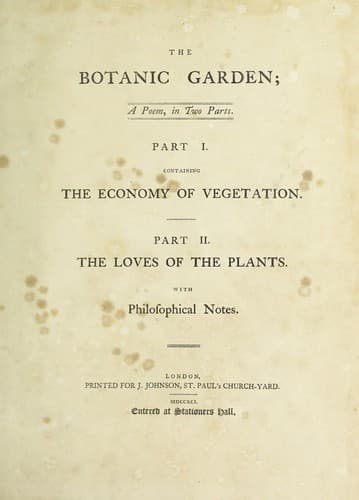
The Botanic Garden. Part 2, Containing the Loves of the Plants. A Poem.: With Philosophical Notes.Darwin, Erasmus
History
The Botanic Garden. Part 2, Containing the Loves of the Plants. A Poem.: With Philosophical Notes.
Darwin, Erasmus
Natural history; Plants -- Poetry
Amphibious Nymph, from Nile's prolific bed
200 Emerging TRAPA lifts her pearly head;
Fair glows her virgin cheek and modest breast,
A panoply of scales deforms the rest;
[_Trapa,_ l. 200. Four males, one female. The lower leaves
of this plant grow under water, and are divided into minute capillary
ramifications; while the upper leaves are broad and round, and have
air-bladders in their footstalks to support them above the surface of
the water. As the aerial leaves of vegetables do the office of lungs, by
exposing a large surface of vessels with their contained fluids to the
influence of the air; so these aquatic leaves answer a similar purpose
like the gills of fish; and perhaps gain from water or give to it a
similar material. As the material thus necessary to life seems to abound
more in air than in water, the subaquatic leaves of this plant, and of
sisymbrium, coenanthe, ranunculus aquatilis, water crowfoot, and some
others, are cut into fine divisions to increase the surface; whilst those
above water are undivided. So the plants on high mountains have their
upper leaves more divided, as pimpinella, petroselinum, and others,
because here the air is thinner, and thence a larger surface of contact
is required. The stream of water also passes but once along the gills of
fish, as it is sooner deprived of its virtue; whereas the air is both
received and ejected by the action of the lungs of land-animals. The
whale seems to be an exception to the above, as he receives water and
spouts it out again from an organ, which I suppose to be a respiratory
one. As spring-water is nearly of the same degree of heat in all
climates, the aquatic plants, which grow in rills or fountains, are found
equally in the torrid, temperate, and frigid zones, as water-cress,
water-parsnip, ranunculus, and many others.
In warmer climates the watery grounds are usefully cultivated, as with
rice; and the roots of some aquatic plants are said to have supplied
food, as the ancient Lotus in Egypt, which some have supposed to be the
Nymphæa.--In Siberia the roots of the Butemus, or flowering rush, are
eaten, which is well worth further enquiry, as they grow spontaneously in
our ditches and rivers, which at present produce no esculent vegetables;
and might thence become an article of useful cultivation. Herodotus
affirms, that the Egyptian Lotus grows in the Nile, and resembles a Lily.
That the natives dry it in the sun, and take the pulp out of it, which
grows like the head of a poppy, and bake it for bread. Enterpe. Many
grit-stones and coals, which I have seen, seem to bear an impression of
the roots of the Nymphæa, which are often three or four inches thick,
especially the white-flowered one.]
Public-domain text, read in full here on John Shaqi.
Reviews
Reviews
No reviews yet
Be the first to share your thoughts on this work.
Elsewhere in the archive
Join the Discussion
Join the discussion
Sign in to leave a comment or review.
Sign InorCreate an account