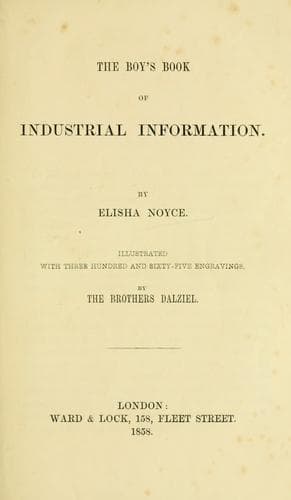
The Boy's Book of Industrial InformationNoyce, Elisha
General
The Boy's Book of Industrial Information
Noyce, Elisha
Industrial arts -- Juvenile literature; Technology -- Juvenile literature
piston, so that the weight of the air should cause this to descend
with considerable force--15 lbs. on the square inch. The piston
was balanced by a weight, so that the steam might raise it with
scarcely any pressure; the steam beneath the piston being condensed
by a stream of cold water, the weight of the air again forced down
the piston into the vacuum. This therefore was not a steam but an
air-engine, as all the power exerted was derived from the weight
of the air, and the steam merely used to procure a vacuum. After
this came the low-pressure or condensing engine, and then the
high-pressure or non-condensing engine, both of which are now used,
the former in marine engines and the latter in locomotives.
Illustration: FLY-WHEEL, WOOLWICH ARSENAL.
Illustration: FIG. 1. BOILERS, WOOLWICH ARSENAL.
Illustration: FIG. 2. BOILERS, WOOLWICH ARSENAL.
The steam-engine consists essentially of a boiler or steam-generator,
with a furnace adapted to it, connected by a steam-pipe to a cylinder
having a piston working accurately in it, and valves so contrived
that the steam shall enter alternately above and below the piston. In
the condensing engine, each compartment, above and below the piston,
communicates with the condenser--the vessel in which the steam is
suddenly condensed by cold water--and the valves are so arranged that
when the steam enters above the piston, the space below is opened
to the condenser, and is therefore a partial vacuum; by the time
the piston is driven down by the force of the steam above it, the
space is shut off from the condenser and opened to the steam-pipe,
while the space above is shut off from the steam-pipe and opened
to the condenser. In this way one side of the piston is alternately
pressed by the steam while there is a vacuum on the other side. In
the non-condensing engine the space above and below the piston is
alternately pressed by steam at a great degree of tension; while at
the opposite side of the piston, the space is opened to the air by a
valve. These valves are what are called “sliding valves,” being both
in connection with the same action, which shuts one while it opens
the other; that is, when the piston has nearly descended, it slides
the valve which shuts off the steam from the space above and opens it
to the air, the same action opening the steam-valve below the piston
and shutting it from the air. In this kind of engine the piston is
moved simply by the power of the steam, which first presses it down
and then presses it up again, and as the steam escapes at each stroke
of the piston, and has to be at a great tension or pressure, a large
and rapidly-formed supply of steam is required. In the locomotive and
other high-pressure engines this is effected by having a great number
of tubes passing through the boiler leading from the fire-place to
the flue, so that the fire and heated air shall pass through them
before reaching the flue, and consequently, as these all pass through
Public-domain text, read in full here on John Shaqi.
Reviews
Reviews
No reviews yet
Be the first to share your thoughts on this work.
Elsewhere in the archive
Join the Discussion
Join the discussion
Sign in to leave a comment or review.
Sign InorCreate an account