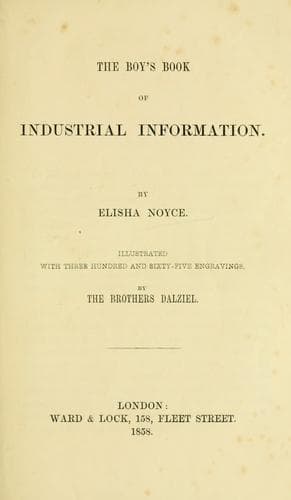
The Boy's Book of Industrial InformationNoyce, Elisha
General
The Boy's Book of Industrial Information
Noyce, Elisha
Industrial arts -- Juvenile literature; Technology -- Juvenile literature
These machines are used for raising heavy bodies in a perpendicular
direction. They are of various forms suitable for almost every
purpose, and to most of them are adapted two or more wheels with
teeth, one small and one large, for the purpose of obtaining power
at the expense of time (fig. 1); the small wheel is turned by a
windlass, and turns the larger one very slowly but with great power.
The common warehouse or cellar crane is generally an iron frame with
two pulleys, and the arrangement shown at fig. 1. which is usually
inside the warehouse, while the crane is outside to raise goods from
carts, &c., into the floors above (fig. 2). Cranes at the sides of
canals or rivers for landing goods are sometimes made as figs. 3 and
4; in the last there is a heavy stone placed to balance the weight
at the end of the crane. What is called the “jib crane” is often
“rigged” up on shipboard for shipping and unshipping goods (fig.
5). Cranes for very heavy purposes have been made upon the tubular
principle and consist of iron plates rivetted together so as to form
a hollow curved crane, similar to the hollow girders used in bridges.
Where goods have to be brought from one particular spot to another,
as in fig. 6, the swing crane is used. Amongst cranes may be named
the hydraulic lift; this is exactly similar to the hydraulic press,
only applied in a different manner, and is used to lift very heavy
weights but short distances, as for raising heavy goods on to railway
trucks, &c.
CRANKS.
Illustration: (‡ KNIFE-GRINDER.)
Illustration: (‡ PISTON CRANK.)
Cranks are bends in the axle of any part of a machine by which an
up-and-down motion is converted into a circular or rotatory one,
as in the common knife grinder’s machine; in this arrangement
a fly-wheel is necessary to continue by its momentum (tendency
to go on) the motion begun by the upward and downward action of
the treadle, piston-rod, &c., as the case may be. The cranks of
steam-vessels are among the heaviest pieces of forging that are
wrought by Nasmyth’s steam hammer, cast-iron being too brittle to
be used for the purpose.
FIRE-ARMS AND PROJECTILES.
Illustration: FIG. 11. MACHINE FOR MAKING MINIÉ RIFLE BULLETS.
Illustration: FIG. 1. MUSKET BORING.
Illustration: FIG. 2. RIFLING PROCESS.
Public-domain text, read in full here on John Shaqi.
Reviews
Reviews
No reviews yet
Be the first to share your thoughts on this work.
Elsewhere in the archive
Join the Discussion
Join the discussion
Sign in to leave a comment or review.
Sign InorCreate an account