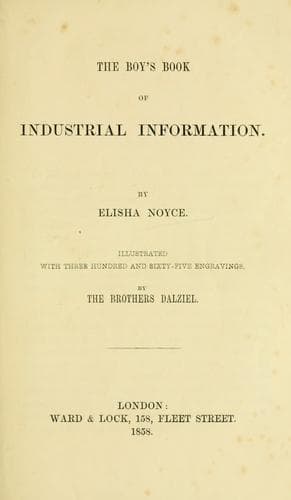
The Boy's Book of Industrial InformationNoyce, Elisha
General
The Boy's Book of Industrial Information
Noyce, Elisha
Industrial arts -- Juvenile literature; Technology -- Juvenile literature
Scarcely any kind of machinery can be constructed without wheels of
some kind--they serve almost numberless purposes. The fly-wheel (fig.
1) serves to produce a continuous motion, from its size and weight
giving it a tendency to go on, and in this way causing it to fill up
the intervals of unequal action, as in the ascent and descent of the
piston in a steam-engine. The toothed-wheel serves to give motion
to other wheels, and this at a certain rate either greater or less
than its own, according to its size, and consequently the number of
its teeth; thus a wheel with a hundred “cogs” or teeth united to one
with but fifty, causes this to go round twice while the larger one
passes round but once; but a large wheel turned round by a small
one, although it moves more slowly yet does so with increased power
just in proportion to its slowness (fig. 2). The bevel-wheel (fig. 3)
is used to change the direction of a shaft, and for all the other
purposes of a toothed-wheel, from which it differs only in the
position of the teeth or cogs. Wheels are sometimes made to answer
the purposes of bevel wheels, by having the cogs on the surface of
the one wheel, and the other as an ordinary toothed-wheel (fig. 4).
The ratchet-wheel (fig. 5) is a wheel with its teeth pointing
in one direction like the teeth of a saw, and into which a tongue
of iron is made to fall, so that the wheel can only be turned in
one direction. These wheels are used where the machinery is liable
to run back if left, as in the “crane,” &c. The capstan (fig. 6)
is a kind of ratchet wheel, and is so made that long spokes may be
placed in the holes, to be moved round by men, and taken away when
out of use; it is a very powerful piece of machinery, and is used
for “weighing anchor” (see “Anchors”). The pulley (fig. 7) is a
series of wheels used to increase power by diminishing the rate of
movement; they are much used in the rigging of ships, and are then
called “blocks.” There are different ways of connecting wheels so as
to communicate the motion of one to another; they may be toothed as
before described, or a “lathe-band” may be passed over them. This
may be either round or cord-like, and made of cat-gut, or flat and
made of leather or gutta-percha. This mode of producing motion is
very useful where evenness and smoothness of action are required,
or where the wheels are at a considerable distance apart; they have
their ends united so as to form a ring, or endless band, and are
sometimes used to communicate motion to a great many wheels, as
seen in fig. 8. The eccentric-wheel has its axis out of the centre;
it is used for the same purpose as a crank, but the action is more
continuous and even. While the crank is most frequently used to
produce a circular or rotatory motion from an up-and-down motion,
the eccentric-wheel is more commonly used to produce an up-and-down
motion from a rotatory one (fig. 9). Wheels take almost every variety
Public-domain text, read in full here on John Shaqi.
Reviews
Reviews
No reviews yet
Be the first to share your thoughts on this work.
Elsewhere in the archive
Join the Discussion
Join the discussion
Sign in to leave a comment or review.
Sign InorCreate an account