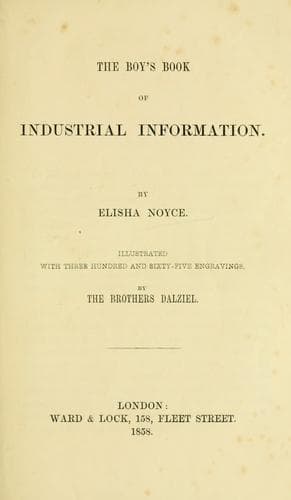
The Boy's Book of Industrial InformationNoyce, Elisha
General
The Boy's Book of Industrial Information
Noyce, Elisha
Industrial arts -- Juvenile literature; Technology -- Juvenile literature
Illustration: (‡ PLOUGH.)
The plough has been in use from the very earliest ages, and has been
but little altered for many centuries; it is drawn by horses attached
to the chain A at the end of the “beam,” and guided by a man holding
the “stilts” or handles B B, the coulter, C, cuts a perpendicular
slice in the ground, and the “share” or “slade,” D, following, cuts
horizontally, so as to separate a long piece of earth which the
breast or mould-board E, placed obliquely, turns over on one side;
the plough returning at regular distances, successive cuttings are
thus laid side by side, forming narrow ridges; F is an additional
coulter called the “skim-coulter,” for removing the surface of the
earth, and is only occasionally used.
There are a great many kinds of ploughs, each suitable to the kind of
soil to be ploughed, whether light and dry or heavy and moist.
HARROWS.
Illustration: HARROW.
These instruments are used to stir up, pulverise, and mix together
the earth, also to tear up any roots that may be left after
ploughing, and to cover up the seed after sowing. The cut represents
the usual form of harrow, having a number of iron spikes or teeth
attached to frames of which two or more are united together by chains
and attached to a bar, that the horses may drag them over the surface
of the soil.
Bush-harrows consist of a bundle of brush-wood held together by a
pair of frames, and drawn over the soil when it is very dry and
light; they are used chiefly to cover up the seed after “drilling.”
ROLLERS.
Illustration: (‡ UNDULATED ROLLERS.)
In clay and other heavy soils, it is necessary after ploughing to
break up the large pieces by means of rollers, and in light soils
to press it together; for these purposes rollers are used, either
with smooth or undulated surfaces, as in the figure; these last form
furrows into which the seed falls, causing it to come up in rows.
Rollers of a lighter kind are used after mowing to level the surface.
MOWING MACHINES.
Illustration: FIG. 1. (‡ SCYTHE.)
Illustration: FIG. 2. (‡ DRAY MOWING MACHINE.)
Public-domain text, read in full here on John Shaqi.
Reviews
Reviews
No reviews yet
Be the first to share your thoughts on this work.
Elsewhere in the archive
Join the Discussion
Join the discussion
Sign in to leave a comment or review.
Sign InorCreate an account