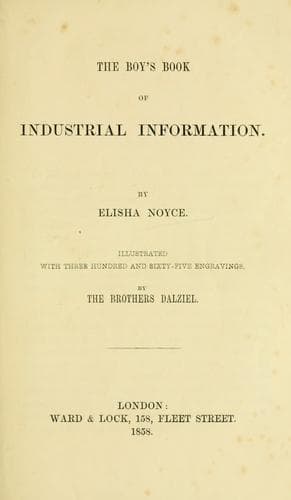
The Boy's Book of Industrial InformationNoyce, Elisha
General
The Boy's Book of Industrial Information
Noyce, Elisha
Industrial arts -- Juvenile literature; Technology -- Juvenile literature
“A series of gutta percha bands, about six inches wide and a quarter
of an inch thick, are coiled on wheels on drums arranged for the
purpose. These bands are studded down both sides with a single row
of holes at short intervals apart. When a message is to be sent
the clerks wind off these bands, inserting in the holes small brass
pins, which, according to their combinations in twos or threes
(with blank holes between), represent certain words or letters. In
this manner the message is, as it were, “set up” in the bands with
great rapidity, and if the number of bands employed is sufficiently
large--say as numerous as the compositors employed in a large
printing-office--messages equal in length to five or six columns
of this journal could be set up and ready for transmission in the
course of a single hour. Of course this operation in no respect
interferes with the telegraph wire itself, which continues free for
use until the bands of messages are actually being despatched. The
gutta percha bands when full are removed to the instrument-room, a
most simple appliance preventing any derangement or falling out of
the pins while being moved about. In the instrument-room the bands
are connected with ordinary steam machinery, by which they are drawn
in regular order with the utmost rapidity between the charged poles
of an electrical machine in such a manner that, during the moment
of each pin’s passing, it forms electrical communication between
the instrument and the telegraph, and a signal is transmitted to
the other end of the wire, where the spark perforates a paper and
records the message. The only limit to the rapidity of the operation
is the rate at which the bands can be drawn, since the electrical
contact of each pin, even for the 200th part of a second, is more
than sufficient to transmit a word or signal from London and register
it in America. Of course, as the message is recorded (we will say in
America) with the same rapidity as that with which it is transmitted
from London, a number of reading clerks will be requisite in order to
translate it, by dividing it into small portions, with almost as much
facility as it has been sent.”
ROADS.
Illustration: (‡ TRAIN BRIDGE OVER ROAD.)
Roads, which were formerly of the utmost importance as the only means
of communication between distant places, and on which an enormous
amount of labour and capital have been expended, are now becoming
rapidly subordinate to railways; however this may be, it is quite
clear that roads can never be superseded by the latter. The numerous
streets of great towns are so many short roads, and on some of them
the amount of traffic is so very great, that the utmost skill of the
engineer is required to resist the consequent wear and tear.
Public-domain text, read in full here on John Shaqi.
Reviews
Reviews
No reviews yet
Be the first to share your thoughts on this work.
Elsewhere in the archive
Join the Discussion
Join the discussion
Sign in to leave a comment or review.
Sign InorCreate an account