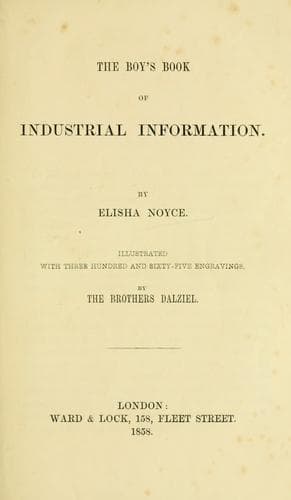
The Boy's Book of Industrial InformationNoyce, Elisha
General
The Boy's Book of Industrial Information
Noyce, Elisha
Industrial arts -- Juvenile literature; Technology -- Juvenile literature
In plate engraving the design is copied from the original and cut
into the plate in a manner quite opposite to that of engraving on
wood; for every line intended to be printed, instead of projecting,
is cut in with a sharp edge, so that they may be filled with ink,
instead of being covered, as in wood engraving. When the design is
formed entirely by lines, it is called “line engraving,” and when
formed by dots, it is said to be “stippled,” and these two kinds are
often combined in the same plate. There is a process for engraving
plates, called “etching,” by which the lines or dots on the plate
are not made by cutting, but are corroded or eaten in by the chemical
action of nitric acid; and few plates are now produced by the graver
alone, the design being first etched and afterwards finished off by
the graver, but some are produced by etching alone, whence they are
called “etchings.” The process of etching is as follows:--The surface
of the plate is made smooth and bright, then heated, and afterwards
coated with a mixture of asphaltum, wax, and mastic--called
“etching-ground”--a ball of which is tied up in a piece of silk,
rubbed over the hot plate, and dabbed with a dabber till a smooth
layer or coating is formed all over it; it is “smoked” over the flame
of a candle, to blacken it, and the result is a smooth black varnish,
which covers the surface of the plate, and is capable of resisting
the action of nitric acid. On this surface the design is drawn with
an “etching-point,” a steel instrument which cuts or scratches quite
through the etching-ground, exposing the surface of the copper at the
bottom of each scratch. When the design is finished--in hues or dots,
according to the style required--a ridge or border of wax is made
all round the plate so as to form it into a sort of shallow tray, and
into this the nitric acid, mixed with a little water, is poured, and
carefully watched till in the judgment of the engraver it has bitten
into the plate sufficiently for the fainter parts of the design.
The acid is then poured off, and the plate washed and dried, after
which the parts intended to remain most lightly etched are stopped
out with varnish, and the acid again poured on, to corrode the lines
left exposed to its action more deeply. This is repeated two or three
times, according to the nature of the design, when the plate is again
heated, to melt the etching-ground, and the whole is cleaned off with
turpentine. The plate may now be used to print from, or it may be
further finished by the “graver,” “burnisher,” or “dry point,” which
is simply a point of steel used to make very fine and faint scratches
instead of cuts, for the graver cuts out the piece of copper, while
the dry point merely indents it.
Public-domain text, read in full here on John Shaqi.
Reviews
Reviews
No reviews yet
Be the first to share your thoughts on this work.
Elsewhere in the archive
Join the Discussion
Join the discussion
Sign in to leave a comment or review.
Sign InorCreate an account