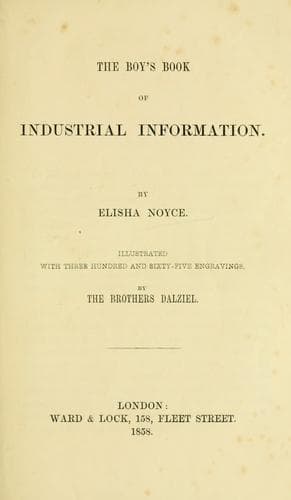
The Boy's Book of Industrial InformationNoyce, Elisha
General
The Boy's Book of Industrial Information
Noyce, Elisha
Industrial arts -- Juvenile literature; Technology -- Juvenile literature
Flax, before being spun into “yarn” for weaving linens, undergoes
several processes, to separate its fibres sufficiently, and to rid
them of all short and uneven portions. The first operation consists
in a kind of fermentation called “retting,” the stalks of the flax
being packed up in bundles and steeped in water, or exposed to
damp air, spread out, till they soften and become fit for the next
process, called “breaking.” This is done by contrivances which beat
and bruise or give it several sharp bends, the object being to break
off the outer part, called the “boon,” and leave the inner fibres
or “harl” free; this, which is the part to be used, is thus in a
great measure freed from the outer part, but to do so completely it
is scraped with a blunt kind of knife till all the “boon” is gone.
The next process is called “heckling,” a sort of combing, in which
the flax is dragged through brushes of fine iron spikes, used closer
and closer till the flax is combed out quite fine and perfectly free
from knots or uneven pieces, being beaten from time to time to break
or separate the fibres. During this process much of the short and
uneven fibres collect in the “heckle,” and is called “tow,” which
has to be separated and the fibres arranged similarly to “carding”
cotton (see “Cotton Manufacture”). The flax has now to be drawn
out, doubled, and drawn out again into “slivers,” also in the same
way that is described for drawing out cotton, and these slivers are
finally twisted into yarn, being previously wetted to take off their
stillness. The yarn is then wound upon bobbins, forming the material
from which linens, muslins, and other goods are woven.
GLASS-PAINTING.
Illustration: CARTOON, OR DESIGNING ROOM.
Illustration: PAINTING.
Public-domain text, read in full here on John Shaqi.
Reviews
Reviews
No reviews yet
Be the first to share your thoughts on this work.
Elsewhere in the archive
Join the Discussion
Join the discussion
Sign in to leave a comment or review.
Sign InorCreate an account