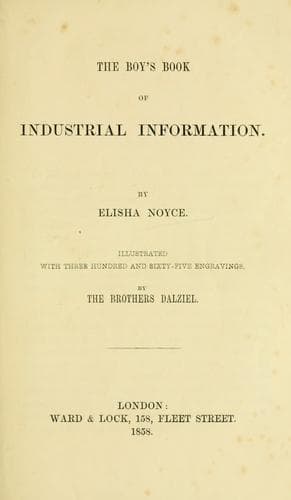
The Boy's Book of Industrial InformationNoyce, Elisha
General
The Boy's Book of Industrial Information
Noyce, Elisha
Industrial arts -- Juvenile literature; Technology -- Juvenile literature
use of a brownish or warm grey tint, which is generally used a little
over all the colors represented in the work. There are some slight
gradations of these brown tints used occasionally, principally when
it is desired to paint the flesh shadows with some separate tint,
but generally it may be understood that the office of the painter
in stained glass is not to produce the colors, but by his brown
shadowing to bring out the design and forms of the composition.
When the glass, thus shaded and outlined, has passed through the
furnace--where the shadows are vitrified--and been allowed gradually
to cool, the glazier fits it together with lead-work, soldering in
all the pieces, then the whole is made weather-tight, and the stained
glass window is complete.
COTTON MANUFACTURE.
Illustration: MULE FRAMES.
Illustration: FRENCH COMBING-MACHINE.
Illustration: “SCOTCHING” OR BLOWING MACHINE.
Illustration: LAP FRAME.
Illustration: CARDING MACHINE.
Illustration: DRAWING MACHINE.
After the cotton is sorted, and the grosser impurities picked from
it by hand, it is dressed by the “combing machine,” or subjected to
a machine (called a “willow,” as it was originally a sort of basket)
contrived to open out and mix the cotton well together, at the same
time blowing off all dust and allowing the heavier impurities to
fall through a grating. The next process is called “scotching,”
and the machine is sometimes called a “blowing machine.” From this
the cotton is passed in a “lap” or thin layer, which is beaten as
it passes, to get rid of dust, and a draught of air produced by a
blowing apparatus assists in the same object; it is thus entirely
freed from all impurities. The cotton is then carried to the “carding
machine,” for the purpose of having its fibres all laid parallel with
each other; this machine is, in fact, a sort of comb, and consists
of cylinders having fine wires projecting from their surfaces acting
in different directions, so as to draw out the fibres till they all
lie in one direction, forming a kind of “fillet,” called a “card,”
which is carried by rollers into a tin can and then subjected to a
process called “drawing and doubling.” As the “card ends” are not
yet sufficiently parallel in their fibres, they have to be passed
between three sets of rollers, the undermost of which are fluted
on their surfaces, the upper ones being covered with flannel. These
rollers act in a peculiar manner; the first pair pass the cotton
at a certain rate on to the second pair, which would pass it on to
the third unchanged if they revolved at the same rate as the first
pair, but they are turned a little faster, and therefore stretch
the fillet of cotton at an even and regular rate, and in such a
manner that it is not broken; the third pair, going faster than
the second, again stretch the fillet. After the fillet has passed
through it is doubled, passed through again and again, till it is
Public-domain text, read in full here on John Shaqi.
Reviews
Reviews
No reviews yet
Be the first to share your thoughts on this work.
Elsewhere in the archive
Join the Discussion
Join the discussion
Sign in to leave a comment or review.
Sign InorCreate an account