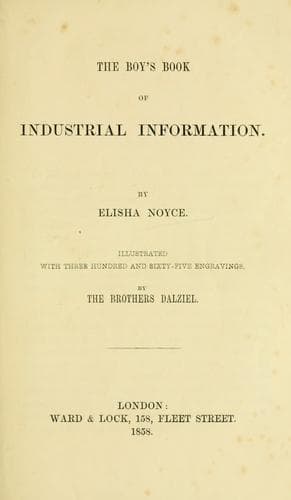
The Boy's Book of Industrial InformationNoyce, Elisha
General
The Boy's Book of Industrial Information
Noyce, Elisha
Industrial arts -- Juvenile literature; Technology -- Juvenile literature
The chief object of bleaching is to get rid of the natural coloring
matter which always tinges cotton, silk, &c., as produced from the
raw material, and also to get rid of any greasy matters, or stains
from accidental causes. Cotton is not only required to be bleached
when intended to remain white, but also before dyeing or printing,
the colors being thereby rendered more uniform and brilliant. The
oldest method of bleaching consisted in simply exposing the goods,
moistened with water, to the action of light and air, by spreading
them out on the grass, and hence the term “grass-bleached;” but
this is by far too tedious a process for the present day, when the
manufacture is so great and the consumption so rapid.
The process of bleaching cotton goods consists in boiling them first
in water, then in a mixture of lime and water, and then in a solution
of soda, soaking them in a solution of chloride of lime, afterwards
in water acidulated with sulphuric acid, and finally in pure water.
Linens are chiefly bleached by repeated boilings in solutions of
potash or pearlash, and afterwards in chloride of lime; wool by
soaking in warm water, exposing it to the vapour of sulphur, and
finally washing in a solution of soft soap.
Illustration: SINGEING APPARATUS.
Illustration: DRYING APPARATUS.
Before being printed, it is necessary that all the loose fibres
should be removed from the surface of the goods. This is effected by
“singeing,” which is done by causing the goods to pass over a red-hot
roller, setting fire to the fine fibres projecting from the surface
only, but with a motion too rapid to allow the fabric to be scorched.
This process, and also the apparatus by which the articles are
dried after bleaching, are shown in the accompanying illustrations.
The latter consists of a series of hollow rollers heated by steam,
over which the goods to be dried are passed, a current of air being
admitted to carry off the vapour.
CALICO-PRINTING.
Illustration: CALICO-PRINTING WORKS.
Illustration: FIG. 1. (‡ PRINTING SCHEMATIC.)
Public-domain text, read in full here on John Shaqi.
Reviews
Reviews
No reviews yet
Be the first to share your thoughts on this work.
Elsewhere in the archive
Join the Discussion
Join the discussion
Sign in to leave a comment or review.
Sign InorCreate an account