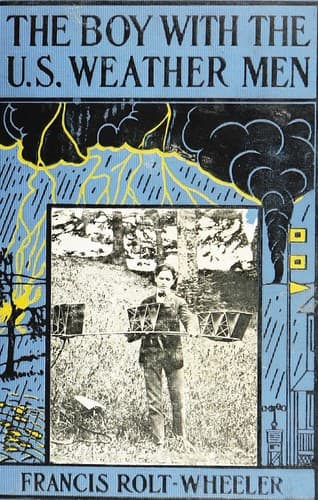
The Boy with the U. S. Weather MenRolt-Wheeler, Francis
General
The Boy with the U. S. Weather Men
Rolt-Wheeler, Francis
United States. Weather Bureau -- Juvenile literature
"'I was nearly drowned and became unconscious, but recovered through
being crushed by the timbers and found myself clinging to my youngest
child, who had gone down with myself and my wife. Mr. J. L. Cline joined
me five minutes later with my other two children, and together with a
woman and child whom we had picked up from the raging waters, we drifted
for three hours, landing three hundred yards from where we started.
There were two hours that we did not see a house or any person, and from
the swell we inferred that we were drifting to sea, which, in view of
the north-east wind that then was blowing, was more than probable.
During the last hour that we were drifting, which was with south-east
and south winds, the wreckage on which we were floating knocked several
residences to pieces. When we landed about 11:30 P. M. by climbing over
floating debris, the water had fallen four feet. It continued falling,
and on the following morning the Gulf was nearly normal.
"'While we were drifting, we had to protect ourselves from flying
timbers by holding planks between us and the wind, and with this
protection we were frequently knocked great distances. Many persons were
killed on top of the drifting debris by flying timbers, after they had
successfully escaped from their wrecked homes. In order to keep on the
top of the floating masses of wrecked buildings, one had to be
constantly on the look-out and continually climbing from drift to drift.
Hundreds of people had similar experiences.'
"Fearful as was the disaster," the Forecaster continued, "it would have
been incalculably worse had it not been for the Weather Bureau warnings.
Hundreds of people were saved by retiring to the upper portion of the
town during the afternoon of the hurricane and no amount of
foreknowledge could have told the sudden four-foot rise in the Gulf.
Galveston learned her lesson, too, as was shown in the recent
hurricane."
"I don't understand those hurricanes a bit," declared Fred, "they don't
seem to act like tornadoes, and instead of coming from the west, like
all the rest of our weather, they come up from the south-east. How is
that, Mr. Levin?"
"The West Indian Hurricanes," the Forecaster replied, "are storms which
are also called tropical 'cyclones' and which in the China Sea are known
as 'typhoons,' and the fearful stories that one has read of the typhoon
in the China seas applies equally to the hurricanes that strike our Gulf
coasts.
"Like all other tropical cyclones, the West Indian Hurricanes are formed
by an upward rising current of air over a moist heated area. There are
five cradles of such storms. One is over the Pacific ocean south-east of
Asia and gives the coast of China, the Philippine Islands and Japan the
typhoon. A second and a third are in the north and the south parts of
the Indian Ocean. A fourth, which is less frequent, is found east of
Australia.
Public-domain text, read in full here on John Shaqi.
Reviews
Reviews
No reviews yet
Be the first to share your thoughts on this work.
Elsewhere in the archive
Join the Discussion
Join the discussion
Sign in to leave a comment or review.
Sign InorCreate an account