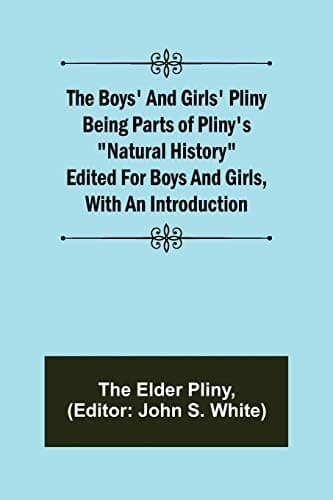
The Boys' and Girls' Pliny: Being parts of Pliny's "Natural History" edited for boys and girls, with an IntroductionPliny, the Elder
History
The Boys' and Girls' Pliny: Being parts of Pliny's "Natural History" edited for boys and girls, with an Introduction
Pliny, the Elder
Animals -- Juvenile literature; Natural history -- Juvenile literature; Physical sciences -- Juvenile literature
The eagle which we have mentioned as forming the third species, pursues
the aquatic birds in the vicinity of standing waters: in order to make
their escape they plunge into the water every now and then, until at
length they are overtaken by lassitude and sleep, upon which the eagle
immediately seizes them. The contest that takes place is really a sight
worthy to be seen. The bird makes for the shore to seek a refuge,
especially if there should happen to be a bed of reeds there; while in
the mean time the eagle endeavors to drive it away with repeated blows
of its wings, and tumbles into the water in its attempts to seize it.
While it is standing on the shore its shadow is seen by the bird, which
immediately dives beneath, and then making its way in an opposite
direction, emerges at some point at which it thinks it is the least
likely to be looked for. This is the reason why these birds swim in
flocks, for when in large numbers they are in no danger from the enemy;
as by dashing up the spray with their wings they blind him.
Again, it often happens that the eagle is not able to carry the bird
aloft on account of its weight, and in consequence they both of them
sink together. This and the haliætus beat their young ones while in an
unfledged state, with their wings, and force them from time to time to
look steadily upon the rays of the sun; and if the parent sees either of
them wink, or even its eye water, it throws it headlong out of the nest,
as being spurious and degenerate, but rears the one whose gaze remains
fixed and steady.
Eagles build among rocks and trees; they lay three eggs, and generally
hatch but two young ones, though occasionally as many as three have been
seen. Being weary of the trouble of rearing both, they drive one of them
from the nest: for just at this time the providential foresight of
Nature has denied them a sufficiency of food, to save the young of all
other animals from becoming their prey. During this period, their talons
become reversed, and their feathers grow white from continued hunger, so
that it is not to be wondered at that they take a dislike to their
young. The ossifrage, however, a kindred species, takes charge of the
young ones thus rejected, and rears them with its own; but the parent
bird still pursues them with hostility, even when grown up, and drives
them away, as being its rivals in rapine. Under any circumstances, one
pair of eagles requires a very considerable space of ground to forage
over, in order to find sufficient sustenance; for which reason they mark
out by boundaries their respective allotments. They do not immediately
carry off their prey, but first deposit it on the ground, test its
weight and then fly away with it.
Public-domain text, read in full here on John Shaqi.
Reviews
Reviews
No reviews yet
Be the first to share your thoughts on this work.
Elsewhere in the archive
Join the Discussion
Join the discussion
Sign in to leave a comment or review.
Sign InorCreate an account