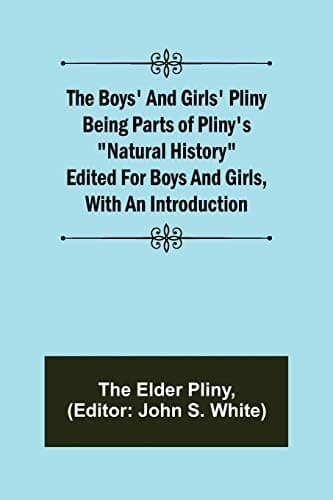
The Boys' and Girls' Pliny: Being parts of Pliny's "Natural History" edited for boys and girls, with an IntroductionPliny, the Elder
History
The Boys' and Girls' Pliny: Being parts of Pliny's "Natural History" edited for boys and girls, with an Introduction
Pliny, the Elder
Animals -- Juvenile literature; Natural history -- Juvenile literature; Physical sciences -- Juvenile literature
The cuckoo seems to be but another form of the hawk,[167] which at a
certain season of the year changes its shape; it being the fact that
during this period no other hawks are to be seen, except, perhaps, for a
few days; the cuckoo itself is only seen for a short period in the
summer, and does not make its appearance after. It is the only one among
the hawks that has not hooked talons; neither is it like the rest of
them in the head, or in any other respect, except the color, while in
the beak it bears a stronger resemblance to the pigeon. In addition to
this, it is devoured by the hawk, if they chance at any time to meet;
this being the only one among the whole race of birds that is preyed
upon by those of its own kind. It changes its voice also with its
appearance, comes out in the spring, and goes into retirement at the
rising of the Dog-star. It always lays its eggs in the nest of another
bird,—mostly a single egg, a thing that is the case with no other bird;
sometimes however, but very rarely, it is known to lay two. It is
supposed, that the reason for its thus substituting its young ones, is
the fact that it is aware how greatly it is hated by all the other
birds;[168] for even the very smallest of them will attack it. So,
thinking that its own race will stand no chance of being perpetuated
unless it contrives to deceive them, it builds no nest of its own: and,
besides, it is a very timid animal. In the mean time, the female bird,
sitting on her nest, is rearing a supposititous and spurious progeny;
while the young cuckoo, which is naturally craving and greedy, snatches
away all the food from the other young ones, and by so doing grows plump
and sleek, and quite gains the affections of his foster-mother; who
takes a great pleasure in his fine appearance, and is quite surprised
that she has become the mother of so handsome an offspring. In
comparison with him, she discards her own young as so many strangers,
until at last, when the young cuckoo is now able to take the wing, he
finishes by devouring her.[169] For sweetness of the flesh, there is not
a bird in existence to be compared to the cuckoo at this season.
The kite, which belongs to the same genus, is distinguished from the
rest of the hawks by its larger size. It has been remarked of this bird,
extremely ravenous as it is, and always craving, that it has never been
known to seize any food either from among funeral oblations or from the
altar of Jupiter at Olympia; nor does it ever seize any of the
consecrated viands from the hands of those who are carrying them; except
where some misfortune is presaged for the town that is offering the
sacrifice. These birds seem to have taught man the art of steering, from
the motion of the tail, Nature pointing out by their movements in the
air the method required for navigating the deep. Kites also disappear
during the winter months, but do not take their departure before the
swallow.
Public-domain text, read in full here on John Shaqi.
Reviews
Reviews
No reviews yet
Be the first to share your thoughts on this work.
Elsewhere in the archive
Join the Discussion
Join the discussion
Sign in to leave a comment or review.
Sign InorCreate an account