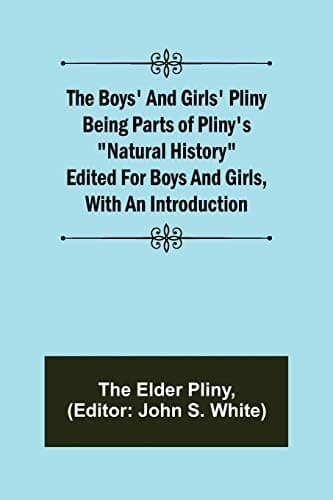
The Boys' and Girls' Pliny: Being parts of Pliny's "Natural History" edited for boys and girls, with an IntroductionPliny, the Elder
History
The Boys' and Girls' Pliny: Being parts of Pliny's "Natural History" edited for boys and girls, with an Introduction
Pliny, the Elder
Animals -- Juvenile literature; Natural history -- Juvenile literature; Physical sciences -- Juvenile literature
Belonging to the genus of birds known as the “vitiparræ,” there is one
whose nest is formed of dried moss,[177] and is in shape so exactly like
a ball, that it is impossible to discover the mouth of it. The bird
known as the acanthyllis, makes its nest of a similar shape, and
interweaves it with pieces of flax. The nest of one of the woodpeckers,
very much like a cup in shape, is suspended by a twig from the end of
the branch of a tree, so that no quadruped may be able to reach it. It
is strongly asserted, that the witwall sleeps suspended by its feet,
because it fancies that by doing so it is in greater safety. In a spirit
of foresight, they select projecting branches of trees that are
sufficiently strong, for the purpose of supporting their nests, and then
arch them over to protect them from the rain, or else shield them by
means of the thickness of the foliage.
In Arabia there is a bird known as the “cinnamolgus,” which builds its
nest with sprigs of cinnamon; the natives knock the nests down with
arrows loaded with lead, in order to sell them. In Scythia there is a
bird, the size of the otis, which produces two young ones always, in a
hare’s skin suspended from the top branches of a tree. Pies, when they
have observed a person steadily gazing at their nest, will immediately
remove their eggs to another place. This is accomplished in a truly
wonderful manner, by such birds as have not toes adapted for holding and
removing their eggs. They lay a twig upon two eggs, and then solder them
to it by means of a glutinous matter secreted from their body; after
which, they pass their neck between the eggs, and so forming an
equipoise, convey them to another place.
No less shrewdness is displayed by those birds which make their nests
upon the ground, because, from the extreme weight of their body, they
are unable to fly aloft. There is a bird, known as the “merops,” which
feeds its parents in their retreat: the color of the plumage is pale on
the inside, and azure without, while it is of a somewhat reddish hue at
the extremity of the wings: this bird builds its nest in a hole which it
digs to the depth of six feet.
Partridges fortify their retreat so well with thorns and shrubs, that it
is effectually protected against beasts of prey. They make a soft bed
for their eggs by burying them in the dust, but do not hatch them where
they are laid: that no suspicion may arise from the fact of their being
seen repeatedly about the same spot, they carry them away to some other
place. The females also conceal themselves in order that they may not be
delayed in the process of incubation, as the males are apt to break the
eggs. The males often fall to fighting among themselves like game-cocks,
and through this very pugnacity, these birds are often taken, as the
leader of the whole covey frequently advances to fight with the
decoy-bird of the fowler; as soon as he is taken, another and then
another will advance, all of which are caught in their turn.
Public-domain text, read in full here on John Shaqi.
Reviews
Reviews
No reviews yet
Be the first to share your thoughts on this work.
Elsewhere in the archive
Join the Discussion
Join the discussion
Sign in to leave a comment or review.
Sign InorCreate an account