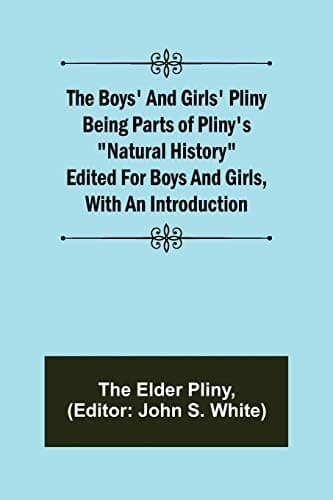
The Boys' and Girls' Pliny: Being parts of Pliny's "Natural History" edited for boys and girls, with an IntroductionPliny, the Elder
History
The Boys' and Girls' Pliny: Being parts of Pliny's "Natural History" edited for boys and girls, with an Introduction
Pliny, the Elder
Animals -- Juvenile literature; Natural history -- Juvenile literature; Physical sciences -- Juvenile literature
What teeth, too, has she inserted in the teredo, to adapt it for
piercing even oak with a sound which fully attests their destructive
power! while at the same time she has made wood its principal nutriment.
We willingly yield our admiration to the shoulders of the elephant as
they support the turret, to the stalwart neck of the bull, and the might
with which it hurls aloft whatever comes in its way, to the onslaught of
the tiger, or to the mane of the lion; while at the same time, Nature is
nowhere to be seen to greater perfection than in the very smallest of
her works. For this reason then, I must beg of my readers,
notwithstanding the contempt they feel for many of these objects, not to
feel a similar disdain for the information I am about to give relative
thereto, seeing that, in the study of Nature, there are none of her
works that are unworthy of our consideration.
CHAPTER II.
WHETHER INSECTS BREATHE, AND WHETHER THEY HAVE BLOOD.
Many authors deny that insects breathe, upon the ground that in their
viscera there is no respiratory organ[188] to be found. They assert that
insects have the same kind of life as plants and trees, there being a
very great difference between respiring and merely having life. On
similar grounds also, they assert that insects have no blood, a thing
which cannot exist, they say, in any animal that is destitute of heart
and liver; just as, according to them, those creatures cannot breathe
which have no lungs. Upon these points, however, a vast number of
questions will naturally arise; for the same writers do not hesitate to
deny that these creatures are destitute also of voice,[189] and this,
notwithstanding the humming of bees, the chirping of grasshoppers, and
the sounds emitted by numerous other insects which will be considered in
their respective places. For my part, whenever I have considered the
subject, I have ever felt persuaded that there is nothing impossible to
Nature, nor do I see why creatures should be less able to live and yet
not inhale, than to respire without being possessed of viscera, a
doctrine which I have already maintained, when speaking of the marine
animals; and that, notwithstanding the density and the vast depth of the
water which would appear to impede all breathing. But what person could
very easily believe that there can be any creatures that fly to and fro,
and live in the very midst of the element of respiration, while, at the
same time, they themselves are devoid of that respiration; that they can
be possessed of the requisite instincts for nourishment, working, and
making provision even for time to come, in the enjoyment too of the
powers of hearing, smelling, and tasting, as well as those other
precious gifts of Nature, address, courage, and skilfulness? That these
creatures have no blood I am ready to admit, just as all the terrestrial
animals are not possessed of it; but they have something similar, by way
of equivalent.[190]
Public-domain text, read in full here on John Shaqi.
Reviews
Reviews
No reviews yet
Be the first to share your thoughts on this work.
Elsewhere in the archive
Join the Discussion
Join the discussion
Sign in to leave a comment or review.
Sign InorCreate an account