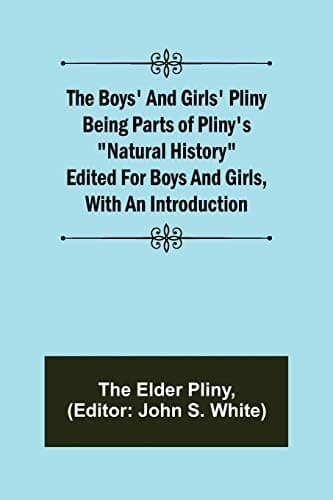
The Boys' and Girls' Pliny: Being parts of Pliny's "Natural History" edited for boys and girls, with an IntroductionPliny, the Elder
History
The Boys' and Girls' Pliny: Being parts of Pliny's "Natural History" edited for boys and girls, with an Introduction
Pliny, the Elder
Animals -- Juvenile literature; Natural history -- Juvenile literature; Physical sciences -- Juvenile literature
Happy omens are sometimes afforded by the swarming of bees, clustering,
as they do, like a bunch of grapes, upon houses or temples; presages
often of great events. Bees settled upon the lips of Plato when still an
infant, announcing thereby the sweetness of that persuasive eloquence
for which he was so noted. Bees settled in the camp of the chieftain
Drusus when he gained the brilliant victory at Arbalo; a proof that the
conjectures of soothsayers are not by any means infallible, for they
consider this always of evil augury. When their leader is withheld from
them, the swarm can always be detained; when lost, it will disperse and
take its departure to find other kings. Without a king, they cannot
exist.
If food fail the inhabitants of any particular hive, the swarm makes a
concerted attack upon a neighboring one, with the view of plundering it.
The swarm attacked at once ranges itself in battle array, and if the
bee-keeper should happen to be present, that side which perceives itself
favored by him will refrain from attacking him. They often fight, for
other reasons, and the two generals are to be seen drawing up their
ranks in battle array against their opponents. The battle is immediately
ended by throwing dust among them, or raising a smoke; and if milk or
honey mixed with water is placed before them, they speedily become
reconciled.
CHAPTER VI.
WASPS AND HORNETS.
Wasps build their nests of mud in lofty places, and make wax: hornets,
on the other hand, build in holes or in the hollows of trees. With these
two kinds the cells are also hexagonal, but, in other respects, though
made of the bark of trees, they strongly resemble the substance of a
spider’s web. Their young are found at irregular intervals, and are of
unshapely appearance; while one is able to fly, another is still a mere
pupa, and a third only in the maggot state. The wasp which is known as
the ichneumon, a smaller kind than the others, kills one kind of spider
in particular, known as the phalangium; after which it carries the body
to its nest, covers it over with a sort of gluey substance, and then
sits and hatches from it its young.[195] In addition to this, they are
all of them carnivorous, while bees will touch no animal substance
whatever. Wasps particularly pursue the larger flies, and after catching
them cut off the head and carry away the remaining portion of the body.
Public-domain text, read in full here on John Shaqi.
Reviews
Reviews
No reviews yet
Be the first to share your thoughts on this work.
Elsewhere in the archive
Join the Discussion
Join the discussion
Sign in to leave a comment or review.
Sign InorCreate an account