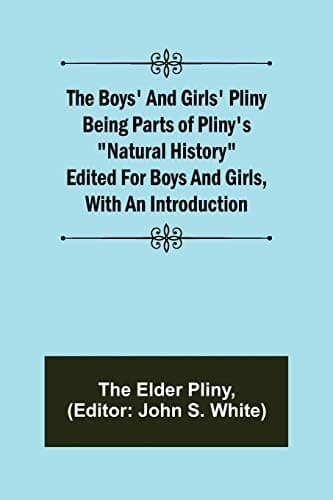
The Boys' and Girls' Pliny: Being parts of Pliny's "Natural History" edited for boys and girls, with an IntroductionPliny, the Elder
History
The Boys' and Girls' Pliny: Being parts of Pliny's "Natural History" edited for boys and girls, with an Introduction
Pliny, the Elder
Animals -- Juvenile literature; Natural history -- Juvenile literature; Physical sciences -- Juvenile literature
His kindness of heart, too, is witnessed by another figure; for in a
chariot and horses which had been executed by Calamis, he himself made
the charioteer, in order that the artist, who excelled in the
representation of horses, might not be considered deficient in the human
figure. This last mentioned artist has executed other chariots also,
some with four horses, and some with two; and in his horses he is always
unrivalled. But that it may not be supposed that he was so greatly
inferior in his human figures, it is as well to remark that his Alcmena
is equal to any that was ever produced.
Lycius was the son and pupil of Myron: he made a figure representing a
boy blowing a nearly extinguished fire, well worthy of his master, as
also figures of the Argonauts. Leochares made a bronze representing the
eagle carrying off Ganymede:[225] the eagle has all the appearance of
being sensible of the importance of his burden, and for whom he is
carrying it, being careful not to injure the youth with his talons, even
through the garments.
Theodorus of Samos,[226] who constructed the Labyrinth at Crete, cast
his own statue in bronze, which was greatly admired not only for its
resemblance, but for the extreme delicacy of the work. In the right hand
he holds a file, and with three fingers of the left, a little model of a
four-horse chariot, which has since been transferred to Præneste: it is
so extremely minute, that the whole piece, both chariot and charioteer,
may be covered by the wings of a fly, which he also made with it.
The most celebrated of all the works, of which I have here spoken, were
dedicated, some time ago, by the Emperor Vespasianus in the Temple of
Peace, and other public buildings of his. They had before been forcibly
carried off by Nero, brought to Rome, and placed by him in the
reception-rooms of his Golden Palace. There is one other famous statue,
the author unknown, which should not be omitted here,—that of Hercules
clothed in the poisoned tunic; it stands near the Rostra, and the
countenance is stern and expressive of his last agonies, caused by that
dress. There are three inscriptions on it; the first of which states
that it had formed part of the spoil obtained by Lucullus the general,
in his war against Mithridates; the second, that his son, while still a
minor, dedicated it in accordance with a decree of the Senate; the
third, that Septimius Sabinus, the curule ædile, had it restored to the
public from the hands of a private individual. So vast has been the
rivalry caused by this statue, and so high the value set upon it.
CHAPTER XII.
IRON.
Public-domain text, read in full here on John Shaqi.
Reviews
Reviews
No reviews yet
Be the first to share your thoughts on this work.
Elsewhere in the archive
Join the Discussion
Join the discussion
Sign in to leave a comment or review.
Sign InorCreate an account