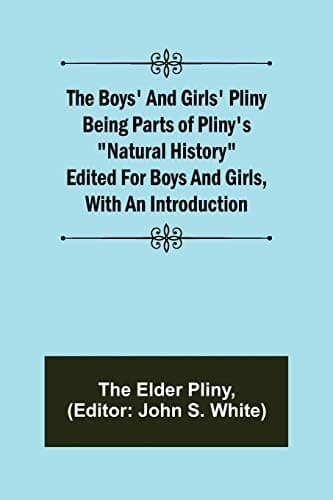
The Boys' and Girls' Pliny: Being parts of Pliny's "Natural History" edited for boys and girls, with an IntroductionPliny, the Elder
History
The Boys' and Girls' Pliny: Being parts of Pliny's "Natural History" edited for boys and girls, with an Introduction
Pliny, the Elder
Animals -- Juvenile literature; Natural history -- Juvenile literature; Physical sciences -- Juvenile literature
These animals possess an intelligence which exceeds all description.
Those who have to use the javelin are well aware how the horse, by its
exertions and the supple movements of its body, aids the rider in any
difficulty he may have in throwing his weapon. They will even present to
their master the weapons collected on the ground. The horses too, that
are yoked to the chariots in the Circus, beyond a doubt display
remarkable proofs how sensible they are to encouragement and to glory.
In the Secular games, which were celebrated in the Circus, under the
Emperor Claudius, when the charioteer Corax, who belonged to the white
party,[112] was thrown from his place at the starting-post, his horses
took the lead and kept it, opposing the other chariots, overturning
them, and doing everything against the other competitors that could have
been done, had they been guided by the most skilful charioteer; and
while we quite blushed to behold the skill of man excelled by that of
the horse, they arrived the winners at the goal, after going over the
whole of the prescribed course. Our ancestors considered it as a still
more remarkable portent, that when a charioteer had been thrown from his
place, in the plebeian games of the Circus, the horses ran to the
Capitol, just as if he had been standing in the car, and went three
times round the temple there. But the greatest prodigy of all, is the
fact that the horses of Ratumenna came from Veii to Rome, with the palm
branch and chaplet, he himself having fallen from his chariot, after
having gained the victory; from which circumstance the Ratumennian gate
derived its name.
[Illustration: ZEBRA.—_Ásinus Zebra._]
When the Sarmatæ are about to undertake a long journey, they prepare
their horses for it, by making them fast the day before, during which
they give them but little to drink; by these means they are enabled to
travel on horseback, without stopping, for one hundred and fifty miles.
Some horses are known to live fifty years. The poet Virgil has very
beautifully described the points which ought more especially to be
looked for, as constituting the perfection of a horse; I myself have
also treated of the same subject, in my work on the Use of the Javelin
by Cavalry, and I find that pretty nearly all writers are agreed
respecting them. The points requisite for the Circus are somewhat
different, however; and while horses are put in training for other
purposes at only two years old, they are not admitted to the contests of
the Circus before their fifth year. We have an account of a horse having
lived to its seventy-fifth year. If a foal has lost its mother, the
other mares in the herd that have young, will take charge of the orphan.
The more spirited a horse is, the deeper does it plunge its nose into
the water while drinking.
Public-domain text, read in full here on John Shaqi.
Reviews
Reviews
No reviews yet
Be the first to share your thoughts on this work.
Elsewhere in the archive
Join the Discussion
Join the discussion
Sign in to leave a comment or review.
Sign InorCreate an account