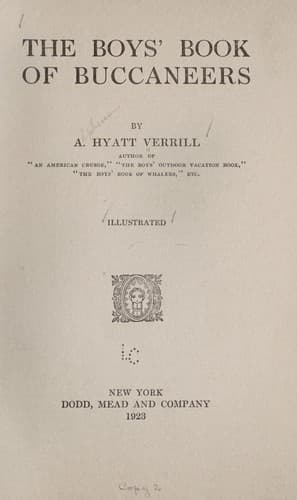
The boys' book of buccaneersVerrill, A. Hyatt (Alpheus Hyatt)
History
The boys' book of buccaneers
Verrill, A. Hyatt (Alpheus Hyatt)
Buccaneers -- Juvenile literature
“Practically,” replied Mr. Bickford. “Teach was the last pirate of
note. There were a few who still lurked in the Caribbean, but the
Atlantic coasts and the West Indies were getting too hot for them. Such
rascals, as Low, England, Roberts and Avery, transferred their
activities to more out-of-the-way spots, to Africa, Madagascar and the
Indian Ocean, and the last of the West Indian pirates were dispersed
and destroyed by Lieutenant, afterwards Commodore, Porter, who also
wiped out the Tripolitan pirates.”
“But how about Lafitte and his pirates?” asked Jack. “I thought they
lived until the time of the war of 1812 and helped General Jackson at
the battle of New Orleans.”
“So they did,” replied his father. “But Lafitte and his brother were
not really pirates. That is, no real acts of piracy were ever proved
against them, although they were denounced as such. In reality the
Lafittes were smugglers, but their career was so picturesque and
romantic that their story may be quite fittingly included in that of
the buccaneers and pirates.
“The two brothers, Jean and Pierre Lafitte, were born in France, and
came to New Orleans in the spring of 1809. They were brilliant, witty,
well educated, attractive men, and spoke several languages fluently.
The two started a blacksmith shop, which they operated by slaves, and
from the first the brothers appeared to have plenty of money. At that
time there was a strip of territory, stretching for a distance of about
sixty miles from the mouth of the Mississippi to Bayou Lafourche, which
was in almost undisputed possession of a colony of smuggler-pirates
known as the ‘Baratarians,’ from the fact that their headquarters were
on the Bay of Barataria, a body of water with a narrow opening
protected from the Gulf by a low, narrow island about six miles long
known as Grande-Terre.
“Some of these Baratarians possessed letters of marque from France, as
well as from the Republic of New Grenada (now Colombia), authorizing
them to prey upon Spanish shipping, but like the pirates of old they
had the reputation of lacking discrimination and of attacking any
vessel that they could overpower. Whatever the truth of their piratical
tendencies may have been, there was no question that they were
smugglers on a large scale, and not long after the Lafittes arrived in
Louisiana they joined their lot with these Baratarians.
“Jean occupied a position as a sort of agent and banker for the
smugglers, but he was far too clever and ambitious to remain long in
such a subordinate capacity, and soon was the head and brains of the
whole organization. To this state he won both by superior intelligence
and force of arms, for both Lafittes were adept swordsmen and expert
pistol shots, and when a fellow called Grambo, a burly leader among the
Baratarians, had the temerity to question Jean Lafitte’s leadership the
latter promptly whipped out a pistol and shot him through the heart.
Public-domain text, read in full here on John Shaqi.
Reviews
Reviews
No reviews yet
Be the first to share your thoughts on this work.
Elsewhere in the archive
Join the Discussion
Join the discussion
Sign in to leave a comment or review.
Sign InorCreate an account