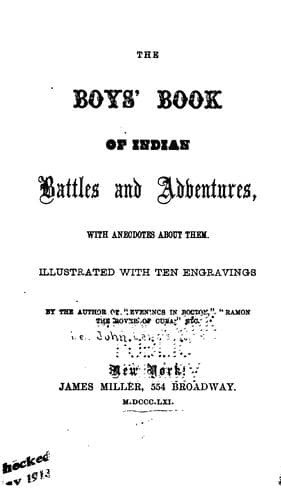
The boys' book of Indian battles and adventures, with anecdotes about them
History
The boys' book of Indian battles and adventures, with anecdotes about them
Indians of North America -- Anecdotes
Prosecuting his route to the land of his parents, he came to the city
of Albany; not the uncivilized savage, not with any of those marks
which bespoke a birth in the forest, or years spent in toiling the wilds
of a desert, but possessing a fine commanding figure, an expressive
countenance, an intelligent eye, with a face scarcely indicative of
the race from which he was descended. He presented, at this period, an
interesting spectacle: a child of the wilderness was beheld about to
proceed to the home of his forefathers, having received the brilliant
advantages of a cultivated mind, and on his way to impart to the nation
that owned him, the benefits which civilization had given him. It was an
opportunity for the philosopher to contemplate, and to reflect on the
future good this young Indian might be the means of producing.
Shortly after his arrival in Albany—where he visited the first
families—he took advantage of Governor Clinton’s journey to Fort Stanwix
(where a treaty was to be held with the Indians,) to return to his tribe.
On the route, Otsaquette amused the company (among whom were the French
Minister, Count De Moustiers, and several gentlemen of respectability)
by his powers on various instruments of music. At Fort Stanwix, he
found himself again with the companions of his early days, who saw and
recognised him. His friends and relations had not forgotten him, and he
was welcomed to his home and to his blanket.
But that which occurred soon after his reception, led him to a too
fearful anticipation of an unsuccessful project; for the Oneidas, as if
they could not acknowledge Otsaquette, attired in the dress with which
he appeared before them,—a mark which did not disclose his nation,—and,
thinking that he had assumed it, as if ashamed of his own native costume,
the garb of his ancestors, they tore it from him with a savage avidity,
and a fiend-like ferociousness, daubed on the paint to which he had
been so long unused, and clothed him with the uncouth habiliments held
sacred by his tribe. Their fiery ferocity, in the performance of the act,
showed but too well the bold stand they were about to take against the
innovations they supposed Otsaquette was to be the agent for affecting
against their immemorial manners and customs, and which, from the
venerable antiquity of their structure, it would be nothing short of
sacrilege to destroy.
Thus the reformed savage was taken back again to his native barbarity,
and—as if to cap the climax of degradation to a mind just susceptible of
its own powers—was _married to a squaw_!
Public-domain text, read in full here on John Shaqi.
Reviews
Reviews
No reviews yet
Be the first to share your thoughts on this work.
Elsewhere in the archive
Join the Discussion
Join the discussion
Sign in to leave a comment or review.
Sign InorCreate an account