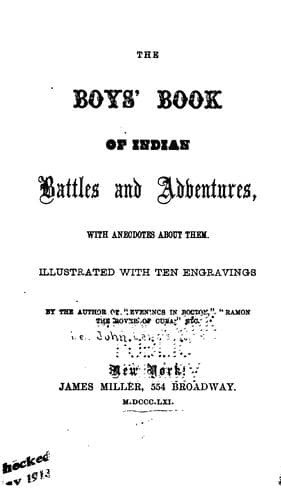
The boys' book of Indian battles and adventures, with anecdotes about them
History
The boys' book of Indian battles and adventures, with anecdotes about them
Indians of North America -- Anecdotes
When the missionaries, on their first arrival, attempted to form an idea
of the Indian mythology, it appeared to them extremely complicated,
more especially because those who attempted to explain it had no fixed
opinions. Each man differed from his neighbour, and at another time from
himself; and when the discrepancies were pointed out, no attempt was made
to reconcile them. The southern tribes, who had a more settled faith, are
described by Adair as intoxicated with spiritual pride, and denouncing
even their European allies as “the accursed people.” The native Canadian,
on the contrary, is said to have been so little tenacious, that he would
at any time renounce all his theological errors for a pipe of tobacco,
though, as soon as it was smoked, he immediately relapsed. An idea was
found prevalent respecting a certain mystical animal, called Mesou or
Messessagen, who, when the earth was buried in water, had drawn it up and
restored it. Others spoke of a contest between the hare, the fox, the
beaver, and the seal, for the empire of the world. Among the principal
nations of Canada, the hare is thought to have attained a decided
preeminence; and hence the Great Spirit and the Great Hare are sometimes
used as synonymous terms. What should have raised this creature to such
distinction seems rather unaccountable; unless it were that its extreme
swiftness might appear something supernatural. Among the Ottowas alone
the heavenly bodies become an object of veneration; the sun appears to
rank as their supreme deity.
Public-domain text, read in full here on John Shaqi.
Reviews
Reviews
No reviews yet
Be the first to share your thoughts on this work.
Elsewhere in the archive
Join the Discussion
Join the discussion
Sign in to leave a comment or review.
Sign InorCreate an account