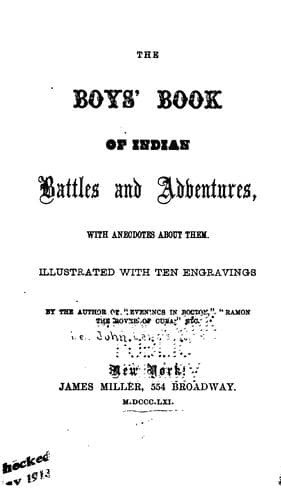
The boys' book of Indian battles and adventures, with anecdotes about them
History
The boys' book of Indian battles and adventures, with anecdotes about them
Indians of North America -- Anecdotes
Attached as the Red man was to his own mode of life, he was induced
at length to form a part of the establishment, in the capacity of
grieve, or head shepherd—a duty he undertook most cheerfully, as it
still left him opportunities of meeting and communing with his friends,
and reconnoitering the altering denizens of the forest. Let us hope,
therefore, that no untoward accident will occur to mar this beautiful
picture of sylvan life; that the M’Dougal colony will wax stronger, till
every section of the prairie is forced to yield tribute to the spade and
the plough.
THE REFORMED INDIAN.
Some of the Indians believe, that the “Evil Spirit” is the maker of
spirituous liquors, from which, notwithstanding, hardly one of them can
refrain. An Indian near the Delaware Water Gap, told Mr. Heckewelder,
a missionary, that he had once, when under the influence of strong
liquor, killed the best Indian friend he had, fancying him to be his
worst avowed enemy. He said that the deception was complete; and that
while intoxicated, the face of his friend presented to _his_ eyes all
the features of the man with whom he was in a state of hostility. It is
impossible to express the horror which struck him, when he awoke from
that delusion. He was so shocked, that from that moment, he resolved
never more to taste of the maddening potion, of which he was convinced
the devil was the inventor; for that it could only be the “Evil Spirit”
who made him see his enemy when his friend was before him, and produced
so strong a delusion on his bewildered senses, that he actually killed
him. From that time until his death, which happened thirty years
afterwards, he never drank a drop of ardent spirits, which he always
called “the devil’s blood;” and was firmly persuaded that the devil, or
some of his infernal spirits, had a hand in preparing it.
FIDELITY.
Among the North American Indians, one of the first lessons they inculcate
on their children, is duty to their parents, and respect for old age;
and there is not among the most civilized nations, any people who more
strictly observe the duty of filial obedience. A father need only to say,
in the presence of his children, “I want such a thing done”—“I want one
of my children to go upon such an errand”—“Let me see who is the good
child that will do it.” The word _good_ operates as it were by magic, and
the children immediately vie with each other to comply with the parent’s
wishes. If a father sees an old decrepid man or woman pass by, led along
by a child, he will draw the attention of his own children to the object,
by saying, “What a _good_ child that must be, which pays such attention
to the aged! That child, indeed, looks forward to the time when it will
likewise be old, and need its children’s help.” Or he will say, “May the
Great Spirit, who looks upon him, grant this _good_ child a long life!”
STRATAGEM DEFEATED.
Public-domain text, read in full here on John Shaqi.
Reviews
Reviews
No reviews yet
Be the first to share your thoughts on this work.
Elsewhere in the archive
Join the Discussion
Join the discussion
Sign in to leave a comment or review.
Sign InorCreate an account