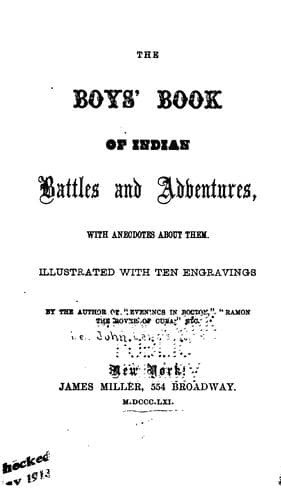
The boys' book of Indian battles and adventures, with anecdotes about them
History
The boys' book of Indian battles and adventures, with anecdotes about them
Indians of North America -- Anecdotes
When Boston was settled _Chickataubut_ visited Governor _Winthrop_, and
presented him with a hogshead of corn. Many of his ‘sanops and squaws’
came with him, but were most of them sent away after they had all dined,
Chickataubut probably fearing they would be burdensome, although it
thundered and rained and the Governor urged their stay. At this time
he wore English clothes, and sat at the Governor’s table, where he
behaved himself soberly, &c. as an Englishman. “Not long after he called
on Governor Winthrop and desired to buy of him a suit of clothes for
himself, the governor informed him that ‘English Sagamores did not use
to truck;’ but he called his tailor and gave him orders to make him a
suit of clothes, whereupon he gave the governor two large skins of coat
beaver. The clothes being ready, the governor put him into a very good
new suit from head to foot, and after, he set meat before them; but he
would not eat till the governor had given thanks, and after meat he
desired him to do the like, and so departed.”
CONDITION OF THE INDIAN WOMEN.
Polygamy is not uncommon among them; and the husband occasionally finds
it necessary to administer a little wholesome castigation to his more
quarrelsome or refractory squaws. But many are satisfied with one wife.
The care of the tent and the whole drudgery of the family devolve on the
women. They gather fuel, cook the provisions, and repair every article
of dress; cultivate the ground, where any is cultivated; carry the
baggage on a journey; and pitch the tent when they halt. In these and
similar employments, their lordly fathers, husbands, and brothers, think
it degrading to assist them, and unworthy of warriors to engage in such
employments.
Mr. Catlin, whose long residence among the Indians, and careful
observation of their habits, entitle his opinion to great respect,
regards the assignment of drudgery to the women as no more than an
equitable distribution of the labour necessary to the support of the
household. He considers the toils of war and the chase, which are almost
incessant, and are solely performed by the men, as a complete offset
to the domestic and agricultural cares of the women. On the whole he
thinks that the condition of the Indian women is as comfortable as it
is possible to render it by any arrangement which would not completely
change their mode of life. To withdraw the men from the chase and
confine them to the culture of the ground, would render the Indians an
agricultural and not a hunting people. Still the condition of the Indian
woman is a miserable and degraded one,—a condition of incessant labour
and care.
Public-domain text, read in full here on John Shaqi.
Reviews
Reviews
No reviews yet
Be the first to share your thoughts on this work.
Join the Discussion
Join the discussion
Sign in to leave a comment or review.
Sign InorCreate an account