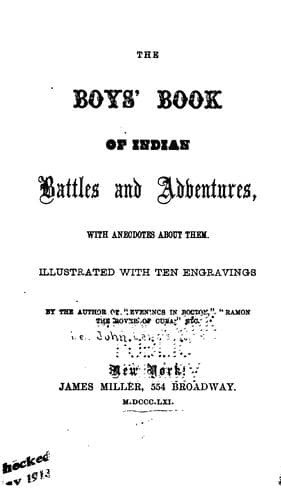
The boys' book of Indian battles and adventures, with anecdotes about them
History
The boys' book of Indian battles and adventures, with anecdotes about them
Indians of North America -- Anecdotes
In none of the tribes do the women experience much tenderness; but among
the Sioux they are so harshly treated, that they occasionally destroy
their female infants, alleging that it is better for them to be put
to death than to live as miserably as they themselves have done. Even
suicide is not uncommon among them, although they believe it offensive to
the Father of Life.
INDIAN EDUCATION.
The Indians never chastise their children, especially the boys; thinking
that it would damp their spirits, check their love of independence, and
cool their martial ardour, which they wish above all things to encourage.
“Reason,” say they, “will guide our children, when they come to the use
of it; and before that, their faults cannot be very great.” They avoid
compulsory measures, and allow the boys to act with uncontrolled freedom;
but endeavour, by example, instruction, and advice, to train them to
diligence and skill in hunting; to animate them with patience, courage,
and fortitude in war; and to inspire them with contempt of danger, pain,
and death,—qualities of the highest order in the estimation of an Indian.
By gentleness and persuasion they endeavour to imbue the minds of their
children with virtuous sentiments, according to their notions of virtue.
The aged chiefs are zealous in this patriotic labour, and the squaws give
their cordial co-operation.
Ishuchenau, an old Kanza warrior, often admonished the group of young
auditors who gathered around him, of their faults, and exhorted them
never to tell a lie, and never to steal, except from an enemy, whom it
is just to injure in every possible way. “When you become men,” said he,
“be brave and cunning in war, and defend your hunting grounds against
all encroachments: never suffer your squaws and little ones to want;
protect them and strangers from insult. On no occasion betray a friend;
be revenged on your enemies; drink not the poisonous strong water of the
white people, for it is sent by the bad spirit to destroy the Indians.
Fear not death; none but cowards fear to die. Obey and venerate old
people, particularly your parents. Fear and propitiate the bad spirit,
that he may do you no harm: love and adore the Good Spirit, who made
us all, who supplies our hunting grounds, and keeps all alive.” After
recounting his achievements, he was wont to add, “Like a decayed prairie
tree, I stand alone:—the friends of my youth, the companions of my
sports, my toils, and my dangers, rest their heads on the bosom of our
mother. My sun is fast descending behind the western hills, and I feel
it will soon be night with me.” Then with hands and eyes lifted towards
heaven, he thanked the Great Spirit for having spared him so long, to
show the young men the true path to glory and fame.
Public-domain text, read in full here on John Shaqi.
Reviews
Reviews
No reviews yet
Be the first to share your thoughts on this work.
Join the Discussion
Join the discussion
Sign in to leave a comment or review.
Sign InorCreate an account