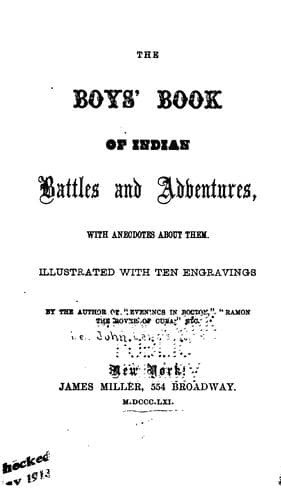
The boys' book of Indian battles and adventures, with anecdotes about them
History
The boys' book of Indian battles and adventures, with anecdotes about them
Indians of North America -- Anecdotes
The devotional exercises of the Indians consist in singing, dancing, and
performing various mystical ceremonies, which they believe efficacious in
healing the sick, frustrating the designs of their enemies, and securing
their own success. They often offer up to the Great Spirit a part of the
game first taken in a hunting expedition, a part of the first produce
of their fields, and a part of their food. At a feast, they first throw
some of the broth, and then of the meat, into the fire. In smoking, they
generally testify their reverence for the Master of life, by directing
the first puff upwards, and the second downwards, or the first to the
rising, and the second to the setting sun: at other times they turn the
pipe to every point of the compass.
They firmly believe in the immortality of the soul, and in a state of
future retribution: but their conceptions on these subjects are modified
and tinged by their occupations in life, and by their notions of good and
evil. They suppose the spirit retains the same inclinations as when in
the body, and rejoices in its old pursuits. At times, an Indian warrior,
when about to kill and scalp a prostrate enemy, addresses him in such
terms as the following:—
“My name is Cashegra: I am a famous warrior, and am going to kill you.
When you reach the land of spirits, you will see the ghost of my father:
tell him it was Cashegra sent you there.” The uplifted tomahawk then
descends upon his victim.
The Mandans[7] expected, when they died, to return to the original
subterraneous abode of their fathers: the good reaching the ancient
village by means of the lake, which the weight of the sins of the bad
will render them unable to pass. They who have behaved themselves well
in this life, and been brave warriors and good hunters, will be received
into the town of brave and generous spirits; but the useless and selfish
will be doomed to reside in the town of poor and useless spirits.
The belief of those untutored children of nature has an influence on
their conduct. Among them the grand defect is, an erroneous estimate of
good and evil, right and wrong.
[Illustration: Destruction of the Pequots.]
DESTRUCTION OF THE PEQUOTS IN 1637.
Public-domain text, read in full here on John Shaqi.
Reviews
Reviews
No reviews yet
Be the first to share your thoughts on this work.
Elsewhere in the archive
Join the Discussion
Join the discussion
Sign in to leave a comment or review.
Sign InorCreate an account