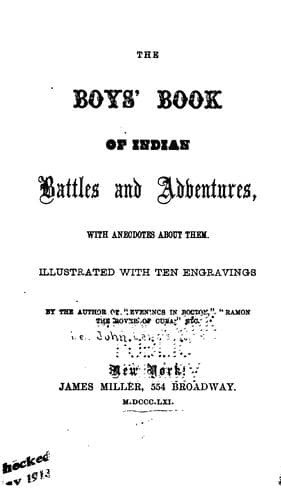
The boys' book of Indian battles and adventures, with anecdotes about them
History
The boys' book of Indian battles and adventures, with anecdotes about them
Indians of North America -- Anecdotes
On looking at the most renowned nations of the ancient heathen world, we
see the people prostrating themselves before innumerable divinities; and
we are ready to conclude that polytheism is the natural belief of man,
unenlightened by revelation. But a survey of the vast wilds of America
will correct this opinion. For there we find a multitude of nations,
widely separated from each other, all believing in One Supreme God, a
great and good spirit, the father and master of life, the maker of heaven
and earth, and of all other creatures. They believe themselves entirely
dependent on him, thank him for present enjoyments, and pray to him for
the good things they desire to obtain. They consider him the author of
all good; and believe he will reward or punish them according to their
deeds.
They believe in inferior spirits also, both good and bad; to whom,
particularly to the good, they give the name of _Manitou_, and consider
them tutelary spirits. The Indians are careful observers of dreams, and
think themselves deserted by the Master of life, till they receive a
manitou in a dream; that is, till they dream of some object, as a buffalo
or beaver, or something else, which they think is an intimation that the
Great Spirit had given them that object as a manitou, or medicine. Then
they are full of courage, and proud of their powerful ally. To propitiate
the manitou, or medicine, every exertion is made, and every personal
consideration sacrificed. “I was lately the proprietor of seventeen
horses,” said a Mandan; “but I have offered them all to my medicine, and
am now poor.” He had turned all these horses, which constituted the whole
of his wealth, loose into the plain, committed them to his medicine,
and abandoned them for ever. But, although they offer oblations to the
manitous, they positively deny that they pay them any adoration, and
affirm that they only worship the Great Spirit through them.
They have no regular periodical time either of private or public
religious worship. They have neither temples, altars, stated ministers
of religion, nor regular sacrifices; for the jugglers are connected
rather with the medical art than with religious services. The Indians in
general, like other ignorant people, are believers in witchcraft, and
think many of their diseases proceed from the arts of sorcerers. These
arts the jugglers pretend to counteract, as well as to cure natural
diseases. They also pretend to predict the weather and to make rain; and
much confidence is placed in their prognostications and their power.
Public-domain text, read in full here on John Shaqi.
Reviews
Reviews
No reviews yet
Be the first to share your thoughts on this work.
Elsewhere in the archive
Join the Discussion
Join the discussion
Sign in to leave a comment or review.
Sign InorCreate an account