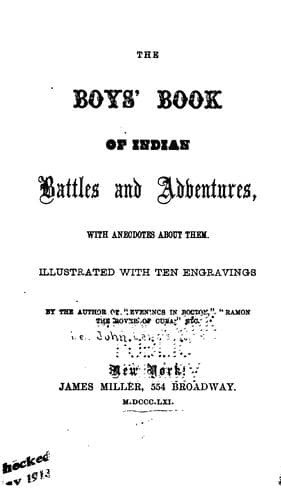
The boys' book of Indian battles and adventures, with anecdotes about them
History
The boys' book of Indian battles and adventures, with anecdotes about them
Indians of North America -- Anecdotes
The circumstances attending the murder of Mr. Cooly’s family, are well
calculated to illustrate the treachery of the Indian character. He
had resided among them for many years, spoke their language well, and
treated them with uniform kindness and hospitality. Indeed, such was his
friendship for them, that he named two of his sons after their chiefs
Alnomock and Montezuma. His wife had once been a captive among them,
and was esteemed a great favourite. Standing in this relation, and
confiding in their professions of friendship, which lulled him into a
fatal security, he left his home for a few days, and returned to find it
desolate. It is a remarkable fact, that the villains who perpetrated the
deed of death, had not the hardihood to scalp the poor mother and her
three innocent children. Was it the recollection of former friendship,
that induced them thus to spare? Or were they conscious that their own
savage colleagues would have blushed for the chivalry of those warriors,
who could find no work more befitting their tomahawks and scalping
knives, than the cruel butchery of women and children? Did they fear that
some chief, more feeling than the rest, would ask,
“Oh wherefore strike the beautiful, the young,
So innocent, unharming? Lift the knife,
If need be, ’gainst the warrior; but forbear
The trembling woman.”
The unfortunate schoolmaster shared a different fate. To him they owed
no obligations of friendship; he was a man, and as such, capable of
resistance; his scalp was therefore torn from him, and borne off as a
testimony of their savage triumph.
PHYSICAL CHARACTER OF THE INDIANS.
In their physical character, the American Indians are considered by
Blumenbach as forming a particular variety of the human species,
differing, though not very widely, from the Mongolian. Believing, as we
do, that the New World was peopled from the Old, and considering that the
Mongol race was situated nearest to the point where Asia and America come
almost into contact, we incline to ascribe these variations merely to a
change of outward circumstances. The face is broad and flat, with high
cheek-bones; more rounded and arched, however, than in the allied type,
without having the visage expanded to the same breadth. The forehead
is generally low; the eyes deep, small, and black; the nose rather
diminutive, but prominent, with wide nostrils; and the mouth large, with
somewhat thick lips. The stature, which varies remarkably throughout the
Continent, is, in the quarter of which we treat, generally above the
middle size. This property, however, is confined to the men, the females
being usually below that standard, a fact which may be confidently
ascribed to the oppressive drudgery they are compelled to undergo.
The limbs, in both sexes, are well proportioned; and few instances of
deformity ever occur.
Public-domain text, read in full here on John Shaqi.
Reviews
Reviews
No reviews yet
Be the first to share your thoughts on this work.
Elsewhere in the archive
Join the Discussion
Join the discussion
Sign in to leave a comment or review.
Sign InorCreate an account