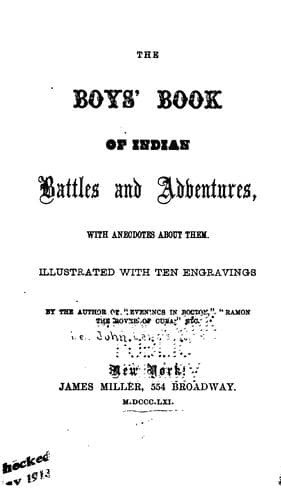
The boys' book of Indian battles and adventures, with anecdotes about them
History
The boys' book of Indian battles and adventures, with anecdotes about them
Indians of North America -- Anecdotes
The comparative physical strength of savage and civilized nations has
been a subject of controversy. A general impression has obtained that
the former, inured to simple and active habits, acquire a decided
superiority; but experience appears to have proved that this conclusion
is ill founded. On the field of battle, when a struggle takes place
between man and man, the Indian is usually worsted. In sportive
exercises, such as wrestling, he is most frequently thrown, and in
leaping comes short of his antagonist. Even in walking or running, if
for a short distance, he is left behind; but in these last movements he
possesses a power of perseverance and continued exertion to which there
is scarcely any parallel. An individual has been known to travel nearly
eighty miles in a day, and arrive at his destination without any symptoms
of fatigue. These long journeys, also, are frequently performed without
any refreshment, and even having the shoulders loaded with heavy burdens,
their capacity of supporting which is truly wonderful. For about twelve
miles, indeed, a strong European will keep ahead of the Indian; but then
he begins to flag, while the other, proceeding with unaltered pace,
outstrips him considerably. Even powerful animals cannot equal them in
this respect. Many of their civilized adversaries, when overcome in war,
and fleeing before them on swift horses, have, after a long chase, been
overtaken and scalped.
DRESS OF THE INDIANS.
Having thus given a view of the persons of the Indians, we may proceed
to consider the manner in which they are clothed and ornamented. This
last object might have been expected to be a very secondary one, among
tribes whose means of subsistence are so scanty and precarious; but, so
far is this from being the case, that there is scarcely any pursuit which
occupies so much of their time and regard. They have availed themselves
of European intercourse to procure each a small mirror, in which, from
time to time, they view their personal decorations, taking care that
everything shall be in the most perfect order. Embellishment, however,
is not much expended on actual clothing, which is simple, and chiefly
arranged with a view to convenience. Instead of shoes, they wear what are
termed moccasins, consisting of one strip of soft leather wrapped round
the foot, and fastened in front and behind. Europeans, walking over hard
roads, soon knock these to pieces; but the Indian, tripping over snow
or grass, finds them a light and agreeable _chaussure_. Upward to the
middle of the thigh, a piece of leather or cloth, tightly fitted to the
limb, serves instead of pantaloons, stockings, and boots; it is sometimes
sewed on so close as never to be taken off. To a string or girdle round
the waist are fastened two aprons, one before and the other at the back,
each somewhat more than a foot square and these are connected by a piece
of cloth like a truss, often used also as a capacious pocket. The use
Public-domain text, read in full here on John Shaqi.
Reviews
Reviews
No reviews yet
Be the first to share your thoughts on this work.
Elsewhere in the archive
Join the Discussion
Join the discussion
Sign in to leave a comment or review.
Sign InorCreate an account