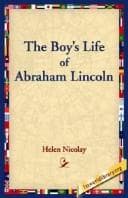
Lincoln, Abraham, 1809-1865; Presidents -- United States -- Biography
world who can pay it, and his name is William Scott. If from this day he
does his duty so that when he comes to die he can truly say 'I have kept
the promise I gave the President. I have done my duty as a soldier,'
then the debt will be paid." Young Scott went back to his regiment, and
the debt was fully paid a few months later, for he fell in battle.
Mr. Lincoln's own son became a soldier after leaving college. The letter
his father wrote to General Grant in his behalf shows how careful he was
that neither his official position nor his desire to give his boy the
experience he wanted, should work the least injustice to others:
Executive Mansion,
Washington, January 19th, 1865.
Lieutenant-General Grant:
Please read and answer this letter as though I was not President, but
only a friend. My son, now in his twenty-second year, having graduated
at Harvard, wishes to see something of the war before it ends. I do not
wish to put him in the ranks, nor yet to give him a commission, to
which those who have already served long are better entitled, and better
qualified to hold. Could he, without embarrassment to you, or detriment
to the service, go into your military family with some nominal rank, I
and not the public furnishing the necessary means? If no, say so without
the least hesitation, because I am as anxious and as deeply interested
that you shall not be encumbered as you can be yourself.
Yours truly,
A. Lincoln.
His interest did not cease with the life of a young soldier. Among his
most beautiful letters are those he wrote to sorrowing parents who
had lost their sons in battle; and when his personal friend, young
Ellsworth, one of the first and most gallant to fall, was killed at
Alexandria, the President directed that his body be brought to the White
House, where his funeral was held in the great East Room.
Though a member of no church, Mr. Lincoln was most sincerely religious
and devout. Not only was his daily life filled with acts of forbearance
and charity; every great state paper that he wrote breathes his faith
and reliance on a just and merciful God. He rarely talked, even with
intimate friends, about matters of belief, but it is to be doubted
whether any among the many people who came to give him advice and
sometimes to pray with him, had a better right to be called a Christian.
He always received such visitors courteously, with a reverence for their
good intention, no matter how strangely it sometimes manifested itself.
A little address that he made to some Quakers who came to see him in
September, 1862, shows both his courtesy to them personally, and his
humble attitude toward God.
Public-domain text, read in full here on John Shaqi.
Reviews
Reviews
No reviews yet
Be the first to share your thoughts on this work.
Elsewhere in the archive
Join the Discussion
Join the discussion
Sign in to leave a comment or review.
Sign InorCreate an account