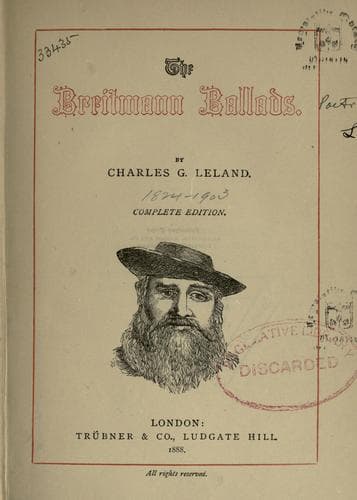
Dialect literature, American; German Americans -- Poetry; Humorous poetry, American; Wit and humor
19. Wurst, literally sausage, is used by German students
to signify indiffer ence. When a sausage is on the table, and
one is asked with mock courtesy which part he prefers, he
naturally replies - "Why, it is all sausage to me." I have heard
an elderly man in New England reply to the query whether he would
have "black meat or breast" - "Any part, thank'ee - I guess it's
all turkey." There are, of course, divers ancient and
quaint puns in Pennsylvania, on such a word as wurst. Thus
it is said that a northern pedlar, in being served with some
sausage of an inferior quality, was asked again if he would have
some of the wurst. Not understanding the word, and
construing it as a slight, he replied to his hostess - "No, thank
you, marm, this is quite bad enough." The literal meaning of
this line, which is borrowed from Scheffel's poem of Perkeo, is
"indifferent, and equal, to me."
20. It was, I believe, Ragnar Lodbrog who, in his Death Song,
spoke, about as intelligently and clearly as Herr Breitmann, of a
mass of weapons.
21. Is true art-enjoyment.
22. Where art thou Breitmann? - Believe it.
23. In the green wood.
24. Students in the streets.
25. Oh Fatherland! - how thou art far!
Oh Time! - how art thou long!
26. Full details of this excursion were published in a pamphlet,
entitled "Three Thousand Miles in a Railroad Car," and also in
letters written by Mr. J. G. Hazzard for the New York
Tribune.
27. In American-German festivals, cards are sometimes sold by the
quantity, which are "good" for refreshments. This is done to
avoid trouble in making change.
28. Breitmann and bride-man, breit and krumm (bride and groom),
or broad and crooked, &c.
29. This refers to the passage of bills in the Legislature of a
state by means of bribery. In Pennsylvania, as in many other
states, bills which have "nothing in them" - i.e. no money
- are rarely allowed to pass.
30. "Die Welt gleicht einer Bierbouteille."
31. Harrisburg is the capital of the state of Pennsylvania.
32. In a certain edition of the Breitmann Ballads, this phrase is
said to have originated in 1845. In 1835, I heard it said that
General Jackson in a letter spelt all correct "oll
korrekt," and this I believe to be the real origin of
the expression. - C.G.L.
33. This incident, and the one narrated in the preceding verse,
are literally true.
Public-domain text, read in full here on John Shaqi.
Reviews
Reviews
No reviews yet
Be the first to share your thoughts on this work.
Elsewhere in the archive
Join the Discussion
Join the discussion
Sign in to leave a comment or review.
Sign InorCreate an account