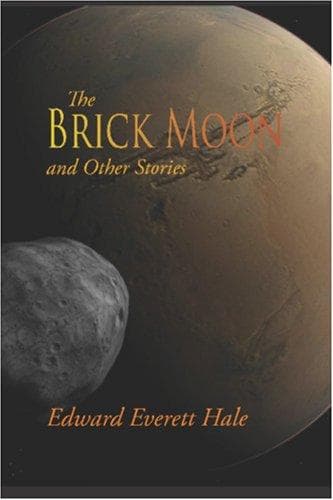
The Brick Moon, and Other StoriesHale, Edward Everett
Science
The Brick Moon, and Other Stories
Hale, Edward Everett
Short stories; United States -- Social life and customs -- 19th century -- Fiction
As he withdrew, whom should be meet but one of his
kindest friends, Commodore Benbow? When the boys made
their "experimental cruise" the year before, they had
found Commodore Benbow's ship at Lisbon. The Commodore
had taken a particular fancy to Tom, because he had known
his mother when they were boy and girl. Tom had even
been invited personally to the flag-ship, and was to have
been presented at Court, but that they sailed too soon.
To tell the whole truth, the Commodore was not
overpleased to see his protege hanging about the bar
and billiard-room on Christmas Day. For himself, his
whole family were living at Willard's, but he knew Tom's
father was not living there, and he thought Tom might be
better employed.
Perhaps Tom guessed this. Perhaps he was in despair.
Anyway he knew "Old Benbow," as the boys called him,
would be a good counsellor. In point of statistics "Old
Benbow" was just turned forty, had not a gray hair in his
head, could have beaten any one of Tom's class, whether
in gunning or at billiards, could have demonstrated every
problem in Euclid while they were fiddling over the
forty-seventh proposition. He was at the very prime of
well-preserved power, but young nineteen called him "Old
Benbow," as young nineteen will, in such cases.
Bold with despair, or with love for his father, Tom
stopped "Old Benbow" and asked him if he would come into
one of the sitting-rooms with him. Then he made this
venerable man his confidant. The Commodore had seen the
slurs in the "Scorpion" and the "Argus" and the "Evening
Journal." "A pity," said he, "that Newspaper Row, that
can do so much good, should do so much harm. What is
Newspaper Row? Three or four men of honor, three or four
dreamers, three or four schoolboys, three or four fools,
and three or four scamps. And the public, Molyneux,--
which is to say you and I,--accept the trumpet blast
of one of these heralds precisely as we do that of
another. Practically," said he, pensively, "when we were
detached to serve with the 33d Corps in Mobile Bay, I
found I liked the talk of those light-infantry men who
had been in every scrimmage of the war, quite as much as
I did that of the bandmen who played the trumpets on
parade. But this is neither here nor there. I thought
of coming round to see your father, but I knew I should
bother him. What can I do, my boy?"
Then Tom told him, rather doubtfully, that he had
reason to fear that Mr. Greenhithe was at the bottom of
the whole scandal. He said he wished he did not think
that Mr. Greenhithe had himself stolen the papers. "If
I am wrong, I want to know it," said he; "if I am right,
I want to know it. I do not want to be doing any man
injustice. But I do not want to keep old Eben Ricketts
down at the department hunting for a file of papers which
Greenhithe has hidden in his trunk or put into the fire."
"No!--no!--no, indeed," said "old Benbow," musing.
"No!--No!--No!--"
Public-domain text, read in full here on John Shaqi.
Reviews
Reviews
No reviews yet
Be the first to share your thoughts on this work.
Elsewhere in the archive
Join the Discussion
Join the discussion
Sign in to leave a comment or review.
Sign InorCreate an account