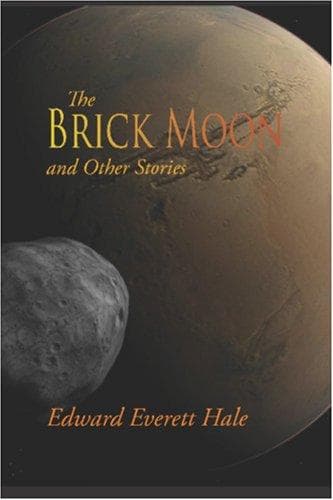
The Brick Moon, and Other StoriesHale, Edward Everett
Science
The Brick Moon, and Other Stories
Hale, Edward Everett
Short stories; United States -- Social life and customs -- 19th century -- Fiction
"And now, papa, will you tell us the story of the
bear? Tom does not tell it very well."
They all laughed,--they could afford to laugh now;
and Mr. Molyneux was just beginning upon the story of the
bear, when Mr. Kuypers reappeared. He had in this short
time revised his toilet, and looked, Mr. Molyneux said in
an aside, like the angel of light that he was. "Bears!"
said he, "are there any bears in Washington? Why,
it was only last Monday that I killed a bear, and I ate
him on Tuesday."
"Did you eat him all?" asked the Brick, whose
reverence for Mr. Kuypers was much more increased by this
story than by any of the unintelligible conversation
which had gone before. But just as Mr. Kuypers began on
the story of the bear, Chloe appeared with beaming face,
and announced that dinner was ready.
That dinner, which this morning every one who had any
sense had so dreaded, and which now seemed a festival
indeed!
Well! there was great pretence in fun and form in
marshalling. And Mr. Kuypers gave his arm to Matty, and
Horace his to Laura, and Beverly his to Flossy, and Tom
brought up the rear with the Brick on his shoulders. And
Mr. Molyneux returned thanks and asked a blessing all
together. And then they fell to, on the turkey and on
the chicken pie. And they tried to talk about Colorado
and mining; about Gold Hill and Hale-and-Norcross, and
Uncle Sam and Overman and Yellow Jacket. But in spite of
them all, the talk would drift back to Bundy and his
various signs, "Our House" and Tom and Jerry; to the wife
of Mr. Whilthaugh; to Commodore Benbow; to old Mrs.
Gilbert and Delaware Avenue. And this was really quite
as much the fault of Mr. Kuypers as it was of any of the
Molyneux family. He seemed as much one of them as did
Tom himself. This anecdote of failure and that of
success kept cropping out. Walsingham's high-bred and
dignified enthusiasm for the triumph of the office, and
the satisfaction that Eben Ricketts would feel when he
was told that the Navy never had the vouchers,--all were
commented on. Then Mr. Molyneux would start and say, "We
are talking shop again. You say the autumn has been mild
in the mountains;" and then in two minutes they would be
on the trail of "Search and Look" again.
It was in one of these false starts that Mr. Kuypers
explained why he came, which in Horace's mind and perhaps
in the minds of the others had been the question most
puzzling of all.
"Why," said Horace, bluntly, "had you ever heard of
papa before!"
"Had I heard of him? " said Mr. Kuypers. "I think
so. Why, my dear boy, your father is my oldest and
kindest friend!" At this exclamation even Mrs. Molyneux
showed amazement. Tom laid down his fork and looked to
see if the man was crazy, and Mr. Molyneux himself was
thrown off his balance.
Mr. Kuypers was a well-bred man, but this time he
could not conceal his amazement. He laid down knife and
fork both, looked up and almost laughed, as he said with
wonder,--
"Don't you know who I am?"
Public-domain text, read in full here on John Shaqi.
Reviews
Reviews
No reviews yet
Be the first to share your thoughts on this work.
Elsewhere in the archive
Join the Discussion
Join the discussion
Sign in to leave a comment or review.
Sign InorCreate an account