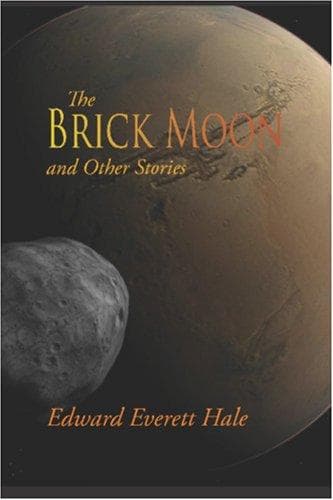
The Brick Moon, and Other StoriesHale, Edward Everett
Science
The Brick Moon, and Other Stories
Hale, Edward Everett
Short stories; United States -- Social life and customs -- 19th century -- Fiction
And here Mr. Joslyn went into a long mathematical
talk, with which I will not harass the reader, perfectly
sure, from other experiments which I have tried with
other readers, that this reader would skip it all if
it were written down. Stated very briefly, it amounted
to this: In the old-fashioned experiments of those days,
a cannon-ball travelled four thousand and one hundred
feet in nine seconds. Now, Joslyn was convinced, like
every other engineman I ever talked to, that on a steep
down-grade he could drive a train at the rate of a
hundred miles an hour. This is thirteen hundred and
fourteen feet in nine seconds,--almost exactly one-third
of the cannon-ball's velocity. At those rates, if the
valley at Chamoguin were really but five-eighths of a
mile wide, the cannon-ball would cross it in seven or
eight seconds, and the train in about twenty-three
seconds. Both Todhunter and Joslyn were good enough
mechanics and machinists to know that the rate for
thirty-three hundred feet, the width of the valley, was
not quite the same as that for four thousand feet; for
which, in their book, they had the calculations and
formulas; but they also knew that the difference was to
their advantage, or the advantage of the bold experiment
which had occurred to both of them when Todhunter had
made on the tender his very critical suggestion.
The reader has already conceived the idea of this
experiment. These rash men were wondering already
whether it were not possible to leap an engine flying
over the Chamoguin ravine, as Eclipse or Flying Childers
might have leaped the brook at the bottom of it. Joslyn
believed implicitly, as I found in talk with him,
the received statement of conversation, that Eclipse, at
a single bound, sprang forty feet. "If Eclipse, who
weighed perhaps one thousand two hundred, would spring
forty feet, could not my train, weighing two hundred
tons, spring a hundred times as far?" asked he
triumphantly. At least, he said that he said this to
Todhunter. They went into more careful studies of
projectiles, to see if it could or could not.
The article on "Gunnery" gave them just one of those
convenient tables which are the blessing of wise men and
learned men, and which lead half-trained men to their
ruin. They found that for their "range," which was, as
they supposed, eleven hundred yards, the elevation of a
forty-two pounder was one degree and a third; of a nine-
pounder, three degrees. The elevation for a railway
train, alas! no man had calculated. But this had
occurred to both of them from the beginning. In
descending the grade, at the spot where, on his little
map, Joslyn made the more westerly X, they were more than
eleven hundred feet above the spot where he had made his
second, or easterly X. All this descent was to the
advantage of the experiment. A gunner would have said
that the first X "commanded" the second X, and that a
battery there would inevitably silence a battery at the
point below.
Public-domain text, read in full here on John Shaqi.
Reviews
Reviews
No reviews yet
Be the first to share your thoughts on this work.
Elsewhere in the archive
Join the Discussion
Join the discussion
Sign in to leave a comment or review.
Sign InorCreate an account