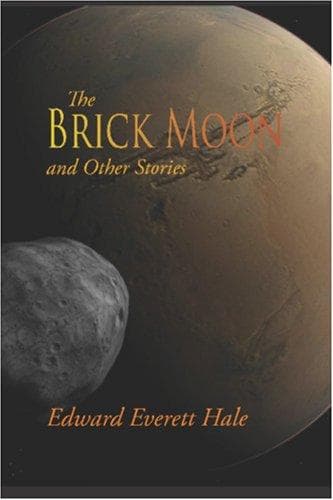
The Brick Moon, and Other StoriesHale, Edward Everett
Science
The Brick Moon, and Other Stories
Hale, Edward Everett
Short stories; United States -- Social life and customs -- 19th century -- Fiction
The social evils, which are a majority of all, would
be reduced by residence in any place where there were not
so many people.
The terrors properly belong to all the classes. In
a decent climate, in a country not governed by its vices,
and a community not crowded, the three terrors would be
materially abated, if not put to an end.
Respectfully submitted,
FELIX CARTER.
How they discussed it now! Talk? I think so! They
all talked awhile, and no one listened. But they had to
stop when Phenice brought in the Welsh rare-bit (good
before bed, but a little indigestible, unless your
conscience is stainless), and Felix then put in a word.
"Now I tell you, this is not nonsense. Why not do
what Winslow and Standish and those fellows thought they
were doing when they sailed? Why not go to a climate
like France, with milder winters and cooler summers than
here? You want some winter, you want some summer."
"I hate centipedes and scorpions," said Anna.
"There's no need of them. There's a place in Mexico,
not a hundred miles from the sea, where you can have your
temperature just as you like."
"Stuff!"
"No, it is not stuff at all," said poor Felix,
eagerly. "I do not mean just one spot. But you live in
this valley, you know. If you find it is growing hot,
you move about a quarter of a mile to another place
higher up. If you find that hot, why you have another
house a little higher. Don't you see? Then, when winter
comes, you move down."
"Are there many people there?" asked Haliburton; "and
do they make many calls?"
"There are a good many people, but they are a gentle
set. They never quarrel. They are a little too high up
for the revolutions, and there is something
tranquillizing about the place; they seldom die,
none are sick, need no aguardiente, do what the head of
the village tells them to do--only he never has any
occasion to tell them. They never make calls."
"I like that," said Ingham. That patriarchal system
is the true system of government."
"Where is this place?" said Anna, incredulously.
"I have been trying to remember all day, but I can't.
It is in Mexico, I know. It is on this side of Mexico.
It tells all about it in an old `Harper'--oh, a good many
years ago--but I never bound mine; there are always one
or two missing every year. I asked Fausta to look for
it, but she was busy. I thought," continued poor Felix,
a little crestfallen, "one of you might remember."
No, nobody remembered; and nobody felt much like
going to the public library to look, on Carter's rather
vague indications. In fact, it was a suggestion of
Haliburton's that proved more popular.
Haliburton said he had not laid in his coal. They
all said the same. "Now," said he, "the coal of this
crowd for this winter will cost a thousand dollars, if
you add in the kindling and the matches, and patching the
furnace pots and sweeping the chimneys."
To this they agreed.
Public-domain text, read in full here on John Shaqi.
Reviews
Reviews
No reviews yet
Be the first to share your thoughts on this work.
Elsewhere in the archive
Join the Discussion
Join the discussion
Sign in to leave a comment or review.
Sign InorCreate an account