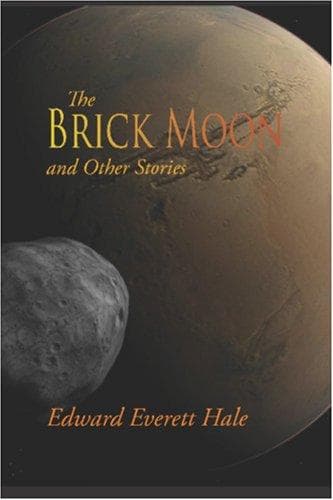
The Brick Moon, and Other StoriesHale, Edward Everett
Science
The Brick Moon, and Other Stories
Hale, Edward Everett
Short stories; United States -- Social life and customs -- 19th century -- Fiction
After one day of bill-paying and house-advertising
and farewelling, they met at Ingham's to "tell their
times." And Julia told of her farewell call on dear Mrs.
Blake.
"The saint!" said she; "she does not see as well as
she did. But it was just lovely there. There was the
great bronze Japanese stork, which seemed so friendly,
and the great vases, and her flowers as fresh as ever,
and her books everywhere. She found something for Tom
and Maud to play with, just as she used to for Ben and
Horace. And we sat and talked of Mexico and Antioch and
everything. I asked her if her eyes troubled her,
and I was delighted because it seems they do not trouble
her at all. She told all about Swampscott and her
grandchildren. I asked her if the dust never troubled
them on Gladstone Street, but she says it does not at
all; and she told all about her son's family in Hong-
Kong. I asked her if the failure of Rupee & Lac annoyed
them, and she said not at all, and I was so glad, for I
had been so afraid for them; and then she told about how
much they were enjoying Macaulay. Then I asked her if
the new anvil factory on the other side of the street did
not trouble her, and she said not at all. And when I
said, `How can that be?' she said, `Why, Julia dear, we
do not let these things trouble us, don't you see. If I
were you, I would not let such things trouble me.'"
George Haliburton laid down his knife as Julia told
the story. "Do you remember Rabia at Mecca? Yes, they
all remembered Rabia at Mecca:--
"Oh heart, weak follower of the weak,
That thou shouldst traverse land and sea;
In this far place that God to seek
Who long ago had come to thee!"
"Why should we not stay here, and not let these
things trouble us?"
Why not, indeed?
And they stayed.
ONE CENT
A CHRISTMAS STORY
DOWN
Mr. Starr rose very early that day. The sun was not
up. Yet, certainly, it was too light to strike a match.
Ah, Mr. Starr, a match may be an economy!
So it was that when, as always, the keys jingled out
from his trousers pockets upon the floor, and the money
as well, one cent rolled under the bureau unseen by Mr.
Starr. He went down to his work now, after he had
gathered up the rest of the money and the keys, and
answered yesterday's letters.
Then, of course, he could loiter over his breakfast.
But not too long. Clara, his wife, was in good
spirits, and the boys were very jolly, but Mr. Starr, all
the same, did the duty next his hand. He "kissed her
good-by," and started down-town. Edgar stopped, him to
ask for fifty cents for his lunch; the postman wanted
fifteen for an underpaid parcel; Susan, the maid, asked
for ten for some extra milk; and then he kissed his hand
to the parlor window, and was off.
No! He was not off.
For Clara threw up the window and waved her lily
hand. Mr. Starr ran back to the door. She flung it
open.
Public-domain text, read in full here on John Shaqi.
Reviews
Reviews
No reviews yet
Be the first to share your thoughts on this work.
Elsewhere in the archive
Join the Discussion
Join the discussion
Sign in to leave a comment or review.
Sign InorCreate an account