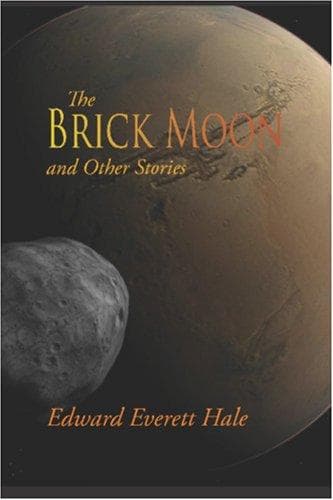
The Brick Moon, and Other StoriesHale, Edward Everett
Science
The Brick Moon, and Other Stories
Hale, Edward Everett
Short stories; United States -- Social life and customs -- 19th century -- Fiction
Having stated all this on a list carefully written,
first in the English language and second in the
language of the Hebrews, Frederick called his fellow-
lodgers together earlier than usual on the evening
before Thanksgiving Day. He explained to them, in the
patois which they used together, that it would be
indecent for them to carry this supply of food farther
than next Monday for their own purposes. He told them
that the occasion was one of exuberant thanksgiving to
the God of heaven. He showed them that they all had
great reason for thanksgiving. And, in short, he made
three heads of a discourse which might have been
expanded by the most eloquent preacher in Boston
the next day, and would have well covered the twenty-
five minutes which the regulation would have required
for a sermon. He then said that, as they had been
favored with much more than they could use for their own
appetites, they must look up those who were not so well
off as themselves.
He was well pleased by finding that he was
understood, and what he said was received with applause
in the various forms in which Southern Russia applauds on
such occasions. As for the two children, their eyes were
wide open, and their mouths, and they looked their
wonder.
Frederick then proposed that two of their number
should volunteer to open a rival establishment at the
polling-booth at the corner of Gates Street and Burgoyne
Street, and that the company should on the next day
invite guests enough to make another table of twelve. He
proposed that the same course should be taken at the
corner of Shapleigh and Bowditch Streets, and yet again
at the booth which is at the corner of Curtis Avenue and
Quincy Street. And he said that, as time would press
upon them, they had better arrange to carry a part at
least of the stores to these places that evening. To
this there was a general assent. The company sat down to
a hasty tea, administered much as the Israelites took
their last meal in Egypt; for every man had on his long
frieze coat and his heavy boots, and they were eager for
the active work of Thanksgiving. For each the
stewards packed two turkeys in a basket, filled in
as far as they could with other stores, and Frederick
headed his procession.
It was then that he was to learn, for the first time,
that he was not the only person in Boston.
It was then that he found out that the revelation
made to one man is frequently made to many.
He found out that he was as wise as the next fellow,
but was no wiser; was as good as the next fellow, but was
no better; and that, in short, he had no special patent
upon his own undertaking,
The little procession soon arrived at the corner of
Shapleigh and Bowditch Streets. Whoever had made the
locks on the doors of the houses had been content to use
the same pattern for all. It proved, therefore, that the
key of No. 237 answered for No. 238, and it was not
necessary to open the door with the "Jimmy" which Simeon
had under his ulster.
Public-domain text, read in full here on John Shaqi.
Reviews
Reviews
No reviews yet
Be the first to share your thoughts on this work.
Elsewhere in the archive
Join the Discussion
Join the discussion
Sign in to leave a comment or review.
Sign InorCreate an account