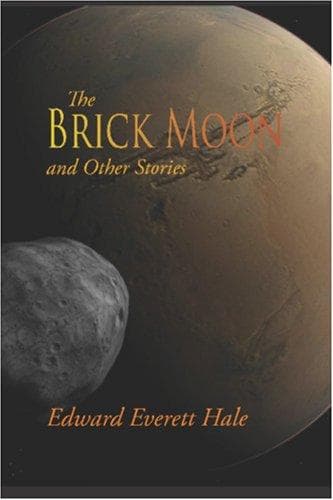
The Brick Moon, and Other StoriesHale, Edward Everett
Science
The Brick Moon, and Other Stories
Hale, Edward Everett
Short stories; United States -- Social life and customs -- 19th century -- Fiction
When I was on the "Tribune" [he never was on the
"Tribune" an hour, unless he calls selling the "Tribune"
at Fort Plains being on the "Tribune." But I tell the
story as he told it. He said:] When I was on the
"Tribune," I was despatched to report Mr. Webster's great
reply to Hayne. This was in the days of stages. We had
to ride from Baltimore to Washington early in the morning
to get there in time. I found my boots were gone from my
room when the stage-man called me, and I reported that
speech in worsted slippers my wife had given me the week
before. As we came into Bladensburg, it grew light, and
I recognized my boots on the feet of my fellow-
passenger,--there was but one other man in the stage. I
turned to claim them, but stopped in a moment, for it was
Webster himself. How serene his face looked as he slept
there! He woke soon, passed the time of day, offered me
a part of a sandwich, for we were old friends,--I was
counsel against him in the Ogden case. Said Webster to
me, "Steele, I am bothered about this speech; I have a
paragraph in it which I cannot word up to my mind;" and
he repeated it to me. "How would this do?" said he.
"`Let us hope that the sense of unrestricted freedom may
be so intertwined with the desire to preserve a
connection of the several parts of the body politic, that
some arrangement, more or less lasting, may prove in a
measure satisfactory.' How would that do?"
I said I liked the idea, but the expression seemed
involved.
"And it is involved," said Webster; "but I can't
improve it."
"How would this do?" said I.
"`LIBERTY AND UNION, NOW AND FOREVER, ONE AND
INSEPARABLE!'"
"Capital!" he said, "capital! write that down for
me." At that moment we arrived at the Capitol steps. I
wrote down the words for him, and from my notes he read
them, when that place in the speech came along.
All of us applauded the story.
Phebe then told
THE SCHOOLMISTRESS'S STORY
You remind me of the impression that very speech made
on me, as I heard Henry Chapin deliver it at an
exhibition at Leicester Academy. I resolved then that I
would free the slave, or perish in the attempt. But how?
I, a woman--disfranchised by the law? Ha! I saw!
Public-domain text, read in full here on John Shaqi.
Reviews
Reviews
No reviews yet
Be the first to share your thoughts on this work.
Elsewhere in the archive
Join the Discussion
Join the discussion
Sign in to leave a comment or review.
Sign InorCreate an account