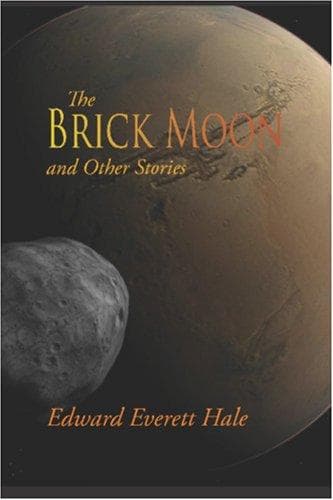
The Brick Moon, and Other StoriesHale, Edward Everett
Science
The Brick Moon, and Other Stories
Hale, Edward Everett
Short stories; United States -- Social life and customs -- 19th century -- Fiction
At the time you speak of I was the private governess
of two lovely boys, Julius and Pompey--Pompey the senior
of the two. The black-eyed darling! I see him now. I
also see, hanging to his neck, his blue-eyed brother, who
had given Pompey his black eye the day before. Pompey
was generous to a fault; Julius parsimonious beyond
virtue. I, therefore, instructed them in two different
rooms. To Pompey I read the story of "Waste not, want
not." To Julius, on the other hand, I spoke of the
All-love of his great Mother Nature, and her profuse
gifts to her children. Leaving him with grapes and
oranges, I stepped back to Pompey, and taught him how to
untie parcels so as to save the string. Leaving him
winding the string neatly, I went back to Julius, and
gave him ginger-cakes. The dear boys grew from year to
year. They outgrew their knickerbockers, and had
trousers. They outgrew their jackets, and became men;
and I felt that I had not lived in vain. I had conquered
nature. Pompey, the little spendthrift, was the honored
cashier of a savings-bank, till he ran away with the
capital. Julius, the miser, became the chief croupier at
the New Crockford's. One of those boys is now in Botany
Bay, and the other is in Sierra Leone!
"I thought you were going to say in a hotter place,"
said John Blatchford; and he told his story.
THE STOKER'S STORY
We were crossing the Atlantic in a Cunarder. I was
second stoker on the starboard watch. In that horrible
gale we spoke of before dinner, the coal was exhausted,
and I, as the best-dressed man, was sent up to the
captain to ask him what we should do. I found him
himself at the wheel. He almost cursed me, and bade me
say nothing of coal, at a moment when he must keep
her head to the wind with her full power, or we were
lost. He bade me slide my hand into his pocket, and take
out the key of the after freight-room, open that, and use
the contents for fuel. I returned hastily to the engine-
room, and we did as we were bid. The room contained
nothing but old account books, which made a hot and
effective fire.
On the third day the captain came down himself into
the engine-room, where I had never seen him before,
called me aside, and told me that by mistake he had given
me the wrong key; asking me if I had used it. I pointed
to him the empty room; not a leaf was left. He turned
pale with fright. As I saw his emotion, he confided to
me the truth. The books were the evidences or accounts
of the British national debt; of what is familiarly known
as the Consolidated Fund, or the "Consols." They had
been secretly sent to New York for the examination of
James Fiske, who had been asked to advance a few millions
on this security to the English Exchequer, and now all
evidence of indebtedness was gone!
Public-domain text, read in full here on John Shaqi.
Reviews
Reviews
No reviews yet
Be the first to share your thoughts on this work.
Elsewhere in the archive
Join the Discussion
Join the discussion
Sign in to leave a comment or review.
Sign InorCreate an account