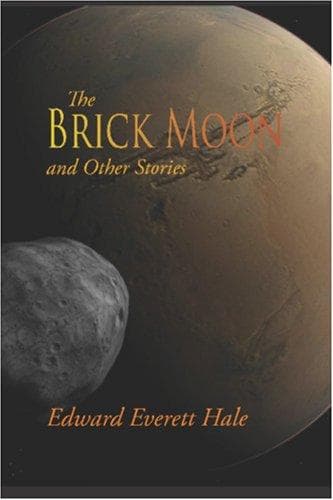
The Brick Moon, and Other StoriesHale, Edward Everett
Science
The Brick Moon, and Other Stories
Hale, Edward Everett
Short stories; United States -- Social life and customs -- 19th century -- Fiction
On the 11th of February, in the year 1867, my old
master died, to my great regret, and I truly believe to
that of his widow and her children. His death broke up
the establishment, and I, who was always more of a
cabinet-maker or joiner than carpenter or builder, opened
a little shop of my own, where I took orders for
cupboards, drawers, stairs, and other finishing work, and
where I employed two or three German journeymen, and was
thus much more master of my own time. In particular, I
had two faithful fellows, natives of my own father's town
of Bremen. While they were with me I could leave them a
whole afternoon at a time, while I took any little job
there might be, and worked at it at my own house at home.
Where my house was, except that it was far uptown, they
never asked, nor ever, so far as I know, cared. This
gave me the chance for many a pleasant afternoon with my
mother, such as we had dreamed of in the old days when we
talked of Kansas. I would work at the lathe or the bench
and she would read to me. Or we would put off the bench
till the evening, and we would both go out into the
cornfield together.
And so we lived year after year. I am afraid that we
worshipped each other too much. We were in the
heart of a crowded city, but there was that in our lives
which tended a little to habits of loneliness, and I
suppose a moralist would say that our dangers lay in that
direction.
On the other hand, I am almost ashamed to say that,
as I sat in a seat I had made for myself in old Van der
Tromp's pear-tree, I would look upon my corn and peas and
squashes and tomatoes with a satisfaction which I believe
many a nobleman in England does not enjoy.
Till the youngest of the Fordyce heirs was of age,
and that would not be till 1880, this was all my own. I
was, by right of possession and my own labors, lord of
all this region. How else did the writers on political
economy teach me that any property existed!
I surveyed it with a secret kind of pleasure. I had
not abundance of pears; what I had were poor and few.
But I had abundance of sweet corn, of tomatoes, of peas,
and of beans. The tomatoes were as wholesome as they
were plentiful, and as I sat I could see the long shelves
of them which my mother had spread in the sun to ripen,
that we might have enough of them canned when winter
should close in upon us. I knew I should have potatoes
enough of my own raising also to begin the winter with.
I should have been glad of more. But as by any good
day's work I could buy two barrels of potatoes, I did not
fret myself that my stock was but small.
Meanwhile my stock in bank grew fast. Neither my
mother nor I had much occasion to buy new clothes. We
were at no charge for house-rent, insurance, or taxes.
I remember that a Spanish gentleman, who was fond of me,
for whom I had made a cabinet with secret drawers, paid
me in moidores and pieces-of-eight, which in those times
of paper were a sight to behold.
Public-domain text, read in full here on John Shaqi.
Reviews
Reviews
No reviews yet
Be the first to share your thoughts on this work.
Elsewhere in the archive
Join the Discussion
Join the discussion
Sign in to leave a comment or review.
Sign InorCreate an account