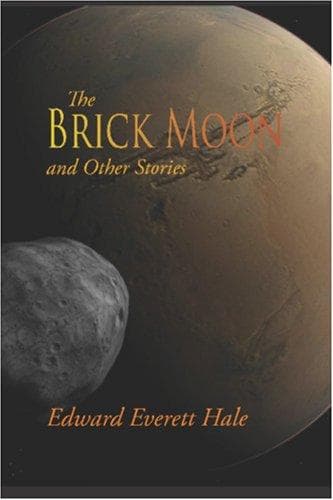
The Brick Moon, and Other StoriesHale, Edward Everett
Science
The Brick Moon, and Other Stories
Hale, Edward Everett
Short stories; United States -- Social life and customs -- 19th century -- Fiction
But surely never any one took fewer of the airs of a
goddess than our Frida did while she was with us. She
would watch my mother, as if afraid that she should put
her hand to a gridiron or a tin dipper. She gave her to
understand, in a thousand pretty ways, that she should be
her faithful, loving, and sincere. servant. If she would
only show her what to do, she would work for her as a
child that loved her. And so indeed she did. My dear
mother would laugh and say she was quite a fine lady now,
for Frida would not let her touch broom nor mop, skimmer
nor dusting-cloth.
The girl would do anything but go out upon an errand.
She could not bear to see the other side of the fence.
What she thought of it all I do not know. Whether she
thought it was the custom in America for young men to
live shut up with their mothers in enclosures of half an
acre square, or whether she thought we two made some
peculiar religious order, whose rules provided that one
woman and one man should live together in a convent or
monastery of their own, or whether she supposed half New
York was made up, as Marco Polo found Pekin, of
cottages or of gardens, I did not know, nor did I much
care. I could see that here was provided a companion for
my mother, who was else so lonely, and I very soon found
that she was as much a companion for me.
So soon as we could understand her at all, I took the
name of her brother and his address. When he wrote last
he was tending a saw-mill at a place about seven miles
away from Tuckahoe, in Jersey. But he said he was going
to leave there at once, so that they need not write
there. He sent the money for their passage, and
promised, as I said, to meet them at New York.
This was a poor clew at the best. But I put a good
face on it, and promised her I would find him if he could
be found. And I spared no pains. I wrote to the
postmaster at Tuckahoe, and to a minister I heard of
there. I inquired of the Swedish consuls in New York and
Philadelphia. Indeed, in the end, I went to Tuckahoe
myself, with her, to inquire. But this was long after.
However, I may say here, once for all, to use an old
phrase of my mother's, we never found "hide nor hair" of
him. And although this grieved Frida, of course, yet it
came on her gradually, and as she had never seen him to
remember him, it was not the same loss as if they had
grown up together.
Meanwhile that first winter was, I thought, the
pleasantest I had ever known in my life. I did not have
to work very hard now, for my business was rather
the laying out work for my men, and sometimes a nice job
which needed my hand on my lathe at home, or in some
other delicate affair that I could bring home with me.
Public-domain text, read in full here on John Shaqi.
Reviews
Reviews
No reviews yet
Be the first to share your thoughts on this work.
Elsewhere in the archive
Join the Discussion
Join the discussion
Sign in to leave a comment or review.
Sign InorCreate an account