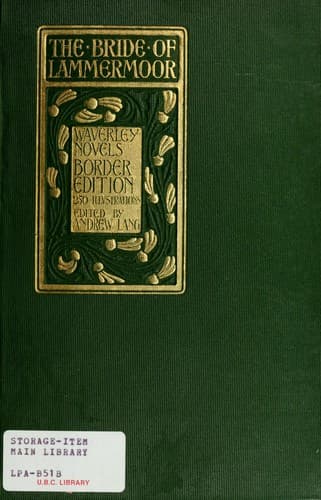
Arranged marriage -- Fiction; Historical fiction; Love stories; Psychological fiction; Scotland -- Fiction; Women murderers -- Fiction
“Hout awa’, auld carle,” said the old dame, “to speak sic daffing to
young folk. But, Jean—fie, woman, dinna ye hear the bairn greet? I’se
warrant it’s that dreary weid has come ower’t again.”
Up got mother and grandmother, and scoured away, jostling each other as
they ran, into some remote corner of the tenement, where the young hero
of the evening was deposited. When Caleb saw the coast fairly clear, he
took an invigorating pinch of snuff, to sharpen and confirm his
resolution.
“Cauld be my cast,” thought he, “if either Bide-the-Bent or Girder
taste that broach of wild-fowl this evening”; and then addressing the
eldest turnspit, a boy of about eleven years old, and putting a penny
into his hand, he said, “Here is twal pennies, my man; carry that ower
to Mrs. Sma’trash, and bid her fill my mill wi’ snishing, and I’ll turn
the broche for ye in the mean time; and she will gie ye a ginge-bread
snap for your pains.”
No sooner was the elder boy departed on this mission than Caleb,
looking the remaining turnspit gravely and steadily in the face,
removed from the fire the spit bearing the wild-fowl of which he had
undertaken the charge, clapped his hat on his head, and fairly marched
off with it, he stopped at the door of the change-house only to say, in
a few brief words, that Mr. Hayston of Bucklaw was not to expect a bed
that evening in the castle.
If this message was too briefly delivered by Caleb, it became absolute
rudeness when conveyed through the medium of a suburb landlady; and
Bucklaw was, as a more calm and temperate man might have been, highly
incensed. Captain Craigengelt proposed, with the unanimous applause of
all present, that they should course the old fox (meaning Caleb) ere he
got to cover, and toss him in a blanket. But Lockhard intimated to his
master’s servants and those of Lord Bittlebrains, in a tone of
authority, that the slightest impertinence to the Master of
Ravenswood’s domestic would give Sir William Ashton the highest
offence. And having so said, in a manner sufficient to prevent any
aggression on their part, he left the public-house, taking along with
him two servants loaded with such provisions as he had been able to
procure, and overtook Caleb just when he had cleared the village.
CHAPTER XIII.
Should I take aught of you? ’Tis true I begged now;
And what is worse than that, I stole a kindness;
And, what is worst of all, I lost my way in’t.
Wit without Money.
Public-domain text, read in full here on John Shaqi.
Reviews
Reviews
No reviews yet
Be the first to share your thoughts on this work.
Elsewhere in the archive
Join the Discussion
Join the discussion
Sign in to leave a comment or review.
Sign InorCreate an account