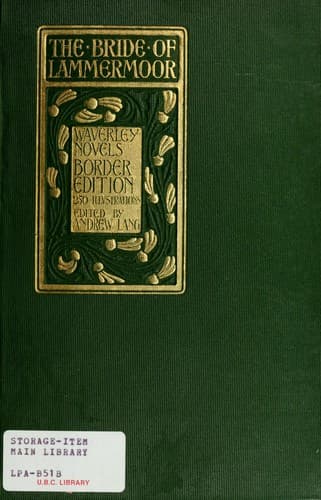
Arranged marriage -- Fiction; Historical fiction; Love stories; Psychological fiction; Scotland -- Fiction; Women murderers -- Fiction
This news, with exaggerations, was speedily carried from various
quarters to the ears of the Lord Keeper, and each reporter dwelt upon
the extreme impatience of the courier, and the surprising short time in
which he had executed his journey. The anxious statesman heard in
silence; but in private Lockhard received orders to watch the courier
on his return, to waylay him in the village, to ply him with liquor, if
possible, and to use all means, fair or foul, to learn the contents of
the letter of which he was the bearer. But as this plot had been
foreseen, the messenger returned by a different and distant road, and
thus escaped the snare that was laid for him.
After he had been in vain expected for some time, Mr. Dingwall had
orders to made especial inquiry among his clients of Wolf’s Hope,
whether such a domestic belonging to the Marquis of A——had actually
arrived at the neighbouring castle. This was easily ascertained; for
Caleb had been in the village one morning by five o’clock, to borrow
“twa chappins of ale and a kipper” for the messenger’s refreshment, and
the poor fellow had been ill for twenty-four hours at Luckie
Sma’trash’s, in consequence of dining upon “saut saumon and sour
drink.” So that the existence of a correspondence betwixt the Marquis
and his distressed kinsman, which Sir William Ashton had sometimes
treated as a bugbear, was proved beyond the possibility of further
doubt.
The alarm of the Lord Keeper became very serious; since the Claim of
Right, the power of appealing from the decisions of the civil court to
the Estates of Parliament, which had formerly been held incompetent,
had in many instances been claimed, and in some allowed, and he had no
small reason to apprehend the issue, if the English House of Lords
should be disposed to act upon an appeal from the Master of Ravenswood
“for remeid in law.” It would resolve into an equitable claim, and be
decided, perhaps, upon the broad principles of justice, which were not
quite so favourable to the Lord Keeper as those of strict law. Besides,
judging, though most inaccurately, from courts which he had himself
known in the unhappy times preceding the Scottish Union, the Keeper
might have too much right to think that, in the House to which his
lawsuits were to be transferred, the old maxim might prevail which was
too well recognised in Scotland in former times: “Show me the man, and
I’ll show you the law.” The high and unbiased character of English
judicial proceedings was then little known in Scotland, and the
extension of them to that country was one of the most valuable
advantages which it gained by the Union. But this was a blessing which
the Lord Keeper, who had lived under another system, could not have the
means of foreseeing. In the loss of his political consequence, he
anticipated the loss of his lawsuit. Meanwhile, every report which
reached him served to render the success of the Marquis’s intrigues the
Public-domain text, read in full here on John Shaqi.
Reviews
Reviews
No reviews yet
Be the first to share your thoughts on this work.
Elsewhere in the archive
Join the Discussion
Join the discussion
Sign in to leave a comment or review.
Sign InorCreate an account