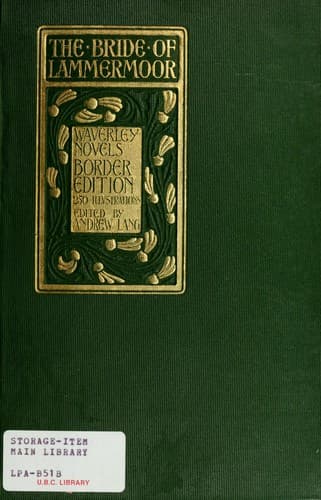
Arranged marriage -- Fiction; Historical fiction; Love stories; Psychological fiction; Scotland -- Fiction; Women murderers -- Fiction
The Lord Keeper opened his discourse with an appearance of unconcern,
marking, however, very carefully, the effect of his communication upon
young Ravenswood.
“You are aware,” he said, “my young friend, that suspicion is the
natural vice of our unsettled times, and exposes the best and wisest of
us to the imposition of artful rascals. If I had been disposed to
listen to such the other day, or even if I had been the wily
politicians which you have been taught to believe me, you, Master of
Ravenswood, instead of being at freedom, and with fully liberty to
solicit and act against me as you please, in defence of what you
suppose to be your rights, would have been in the Castle of Edinburgh,
or some other state prison; or, if you had escaped that destiny, it
must have been by flight to a foreign country, and at the risk of a
sentence of fugitation.”
“My Lord Keeper,” said the Master, “I think you would not jest on such
a subject; yet it seems impossible you can be in earnest.”
“Innocence,” said the Lord Keeper, “is also confident, and sometimes,
though very excusably, presumptuously so.”
“I do not understand,” said Ravenswood, “how a consciousness of
innocence can be, in any case, accounted presumptuous.”
“Imprudent, at least, it may be called,” said Sir William Ashton,
“since it is apt to lead us into the mistake of supposing that
sufficiently evident to others of which, in fact, we are only conscious
ourselves. I have known a rogue, for this very reason, make a better
defence than an innocent man could have done in the same circumstances
of suspicion. Having no consciousness of innocence to support him, such
a fellow applies himself to all the advantages which the law will
afford him, and sometimes—if his counsel be men of talent—succeeds in
compelling his judges to receive him as innocent. I remember the
celebrated case of Sir Coolie Condiddle of Condiddle, who was tried for
theft under trust, of which all the world knew him guilty, and yet was
not only acquitted, but lived to sit in judgment on honester folk.”
“Allow me to beg you will return to the point,” said the Master; “you
seemed to say that I had suffered under some suspicion.”
“Suspicion, Master! Ay, truly, and I can show you the proofs of it; if
I happen only to have them with me. Here, Lockhard.” His attendant
came. “Fetch me the little private mail with the padlocks, that I
recommended to your particular charge, d’ye hear?”
“Yes, my lord.” Lockhard vanished; and the Keeper continued, as if half
speaking to himself.
“I think the papers are with me—I think so, for, as I was to be in this
country, it was natural for me to bring them with me. I have them,
however, at Ravenswood Castle, that I am sure; so perhaps you might
condescend——”
Public-domain text, read in full here on John Shaqi.
Reviews
Reviews
No reviews yet
Be the first to share your thoughts on this work.
Elsewhere in the archive
Join the Discussion
Join the discussion
Sign in to leave a comment or review.
Sign InorCreate an account