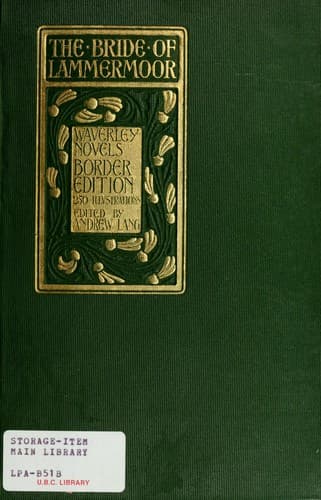
Arranged marriage -- Fiction; Historical fiction; Love stories; Psychological fiction; Scotland -- Fiction; Women murderers -- Fiction
Sir William Ashton, although a man of sense, legal information, and
great practical knowledge of the world, had yet some points of
character which corresponded better with the timidity of his
disposition and the supple arts by which he had risen in the world,
than to the degree of eminence which he had attained; as they tended to
show an original mediocrity of understanding, however highly it had
been cultivated, and a native meanness of disposition, however
carefully veiled. He loved the ostentatious display of his wealth, less
as a man to whom habit has made it necessary, than as one to whom it is
still delightful from its novelty. The most trivial details did not
escape him; and Lucy soon learned to watch the flush of scorn which
crossed Ravenswood’s cheek, when he heard her father gravely arguing
with Lockhard, nay, even with the old housekeeper, upon circumstances
which, in families of rank, are left uncared for, because it is
supposed impossible they can be neglected.
“I could pardon Sir William,” said Ravenswood, one evening after he had
left the room, “some general anxiety upon this occasion, for the
Marquis’s visit is an honour, and should be received as such; but I am
worn out by these miserable minutiae of the buttery, and the larder,
and the very hencoop—they drive me beyond my patience; I would rather
endure the poverty of Wolf’s Crag than be pestered with the wealth of
Ravenswood Castle.”
“And yet,” said Lucy, “it was by attention to these minutiae that my
father acquired the property——”
“Which my ancestors sold for lack of it,” replied Ravenswood. “Be it
so; a porter still bears but a burden, though the burden be of gold.”
Lucy sighed; she perceived too plainly that her lover held in scorn the
manners and habits of a father to whom she had long looked up as her
best and most partial friend, whose fondness had often consoled her for
her mother’s contemptuous harshness.
The lovers soon discovered that they differed upon other and no less
important topics. Religion, the mother of peace, was, in those days of
discord, so much misconstrued and mistaken, that her rules and forms
were the subject of the most opposite opinions and the most hostile
animosities. The Lord Keeper, being a Whig, was, of course, a
Presbyterian, and had found it convenient, at different periods, to
express greater zeal for the kirk than perhaps he really felt. His
family, equally of course, were trained under the same institution.
Ravenswood, as we know, was a High Churchman, or Episcopalian, and
frequently objected to Lucy the fanaticism of some of her own
communion, while she intimated, rather than expressed, horror at the
latitudinarian principles which she had been taught to think connected
with the prelatical form of church government.
Public-domain text, read in full here on John Shaqi.
Reviews
Reviews
No reviews yet
Be the first to share your thoughts on this work.
Elsewhere in the archive
Join the Discussion
Join the discussion
Sign in to leave a comment or review.
Sign InorCreate an account