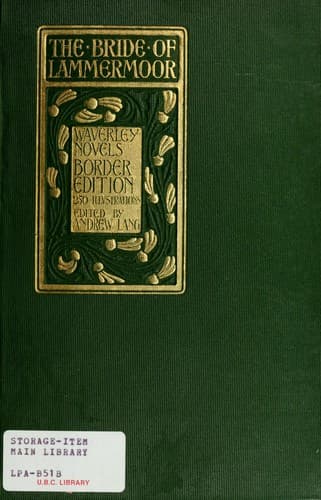
Arranged marriage -- Fiction; Historical fiction; Love stories; Psychological fiction; Scotland -- Fiction; Women murderers -- Fiction
This dialogue plunged Lucy in still deeper dejection, as it tended to
show her plainly what she had for some time suspected, that she was
little better than a prisoner at large in her father’s house. We have
described her in the outset of our story as of a romantic disposition,
delighting in tales of love and wonder, and readily identifying herself
with the situation of those legendary heroines with whose adventures,
for want of better reading, her memory had become stocked. The fairy
wand, with which in her solitude she had delighted to raise visions of
enchantment, became now the rod of a magician, the bond slave of evil
_genii_, serving only to invoke spectres at which the exorcist
trembled. She felt herself the object of suspicion, of scorn, of
dislike at least, if not of hatred, to her own family; and it seemed to
her that she was abandoned by the very person on whose account she was
exposed to the enmity of all around her. Indeed, the evidence of
Ravenswood’s infidelity began to assume every day a more determined
character. A soldier of fortune, of the name of Westenho, an old
familiar of Craigengelt’s, chanced to arrive from abroad about this
time. The worthy Captain, though without any precise communication with
Lady Ashton, always acted most regularly and sedulously in support of
her plans, and easily prevailed upon his friend, by dint of
exaggeration of real circumstances and coming of others, to give
explicit testimony to the truth of Ravenswood’s approaching marriage.
Thus beset on all hands, and in a manner reduced to despair, Lucy’s
temper gave way under the pressure of constant affliction and
persecution. She became gloomy and abstracted, and, contrary to her
natural and ordinary habit of mind, sometimes turned with spirit, and
even fierceness, on those by whom she was long and closely annoyed. Her
health also began to be shaken, and her hectic cheek and wandering eye
gave symptoms of what is called a fever upon the spirits. In most
mothers this would have moved compassion; but Lady Ashton, compact and
firm of purpose, saw these waverings of health and intellect with no
greater sympathy than that with which the hostile engineer regards the
towers of a beleaguered city as they reel under the discharge of his
artillery; or rather, she considered these starts and inequalities of
temper as symptoms of Lucy’s expiring resolution; as the angler, by the
throes and convulsive exertions of the fish which he has hooked,
becomes aware that he soon will be able to land him. To accelerate the
catastrophe in the present case, Lady Ashton had recourse to an
expedient very consistent with the temper and credulity of those times,
but which the reader will probably pronounce truly detestable and
diabolical.
CHAPTER XXXI.
Public-domain text, read in full here on John Shaqi.
Reviews
Reviews
No reviews yet
Be the first to share your thoughts on this work.
Elsewhere in the archive
Join the Discussion
Join the discussion
Sign in to leave a comment or review.
Sign InorCreate an account