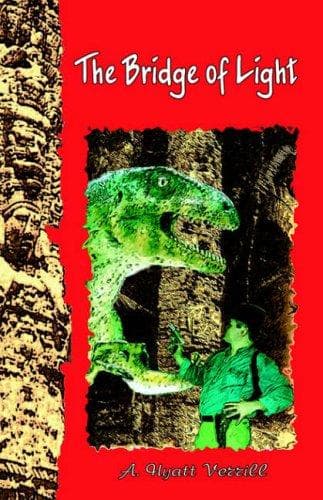
The bridge of lightVerrill, A. Hyatt (Alpheus Hyatt)
Science
The bridge of light
Verrill, A. Hyatt (Alpheus Hyatt)
Adventure stories; Central America -- Fiction; Mayas -- Fiction; Science fiction
WHAT an incongruous, paradoxical situation it was, to be sure. Here
were the people, going mad with excitement over the most primitive
forms of utilizing the most obvious forces of nature, while all
about them, unnoticed, undeveloped, were forces ten thousand times
more powerful, more economical, and which would have caused as much
excitement in the outside world as did the crude wind and water engines
in this hidden valley. Would these people, I wondered, ever learn
to adapt the strange unknown forces of radium to mechanical needs?
In years to come, would they go through the long, slow evolution of
wind, water, steam, electricity, and in the end discover the terrific
forces so long neglected? Would some future Mictolanian rediscover the
inventions of old Nohul Voh and resurrect his name and immortalize
the ancient sorcerer as the greatest scientist of his race? Would his
discoveries be lost and forgotten? Or would some brilliant genius
stumble upon the natural forces of the valley, solve the problem
of controlling and using them and, in a single day--figuratively
speaking--jump his people ages ahead of all other races?
Who could say? Who could foretell what might happen? Possibly old Nohul
Voh. But when I half-jokingly asked him if his Book of the Future had
foretold the wheels and the mills he shook his head and admitted it had
not.
“The Book of the Future holds only those things to do with the race
of the Kitche Maya,” he said. “These things are of another race. As
I could read nothing of your past ere you spoke with Katchilcan, as
I could read nothing of the future beyond the end of the road of the
symbols, neither could I read of these things that dwelt within the
mind of a man of another race.”
I smiled. “You draw a fine line, O, Nohul Voh,” I said. “Though these
things are, as you say, of my race, yet now they have to do with your
people, so they should have been told to you in your Book of the
Future.” “Who can say,” he replied. “It is the will of the gods.” And
he admitted freely that he could not foretell what I next planned to do.
I had noticed that there was iron ore in the valley and there was
also lime. I had no doubt I could build a furnace and smelt the ore,
but there was a simpler method. The natives had smelted copper, gold
and silver for countless ages. Whenever they had done so, they had of
necessity smelted a small quantity of iron at the same time, for all
their ores contained iron. In the bottom of every crucible of the other
metals, there must have been a tiny iron button, and why or how they
had overlooked these bits of the much harder and more useful metal
was a puzzle I could not explain. But that the iron was there I felt
sure, and an examination of the broken clay crucibles and slag that had
accumulated, confirmed my suspicions.
Public-domain text, read in full here on John Shaqi.
Reviews
Reviews
No reviews yet
Be the first to share your thoughts on this work.
Elsewhere in the archive
Join the Discussion
Join the discussion
Sign in to leave a comment or review.
Sign InorCreate an account