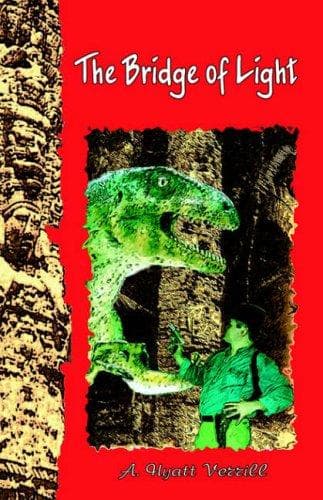
The bridge of lightVerrill, A. Hyatt (Alpheus Hyatt)
Science
The bridge of light
Verrill, A. Hyatt (Alpheus Hyatt)
Adventure stories; Central America -- Fiction; Mayas -- Fiction; Science fiction
He possessed a vast knowledge of medicinal herbs, but he had no
conception of chemistry. He extracted curative salts and drugs from
earths and minerals, but he could not explain their nature, was
entirely ignorant of the difference between acids and alkalis, and he
knew nothing of the laws and theories of chemical reactions. He had
discovered that the radioactive mineral, in combination with certain
ores, emitted a brilliant, apparently perpetual light, but he was
unaware that the light was the result of the decomposition of the
metallic element, radium.
And his most uncanny and seemingly supernatural power, that of
appearing to fade and float through the air, was utterly inexplicable,
he admitted. It was a trick or a power which, he claimed, had been
inherited for countless generations by his clan; it was, so he
declared, purely mental and not mechanical nor chemical, and though
possibly--for I am broad-minded enough to admit there are more
things in heaven and on earth than any scientist has dreamed of in
his philosophy--it may have been the Indian Yogi’s alleged power to
transport themselves bodily for any distance, yet I believed and still
believe it to be some form of hypnotism. He admitted that he could not
perform the seeming miracle, except under certain conditions and in
certain environments, and I mentally classed it with the rope-climbing,
dismembering and mango-growing tricks of the Hindoo fakirs.
But regardless of all this, in spite of the fact that the old sorcerer
was, scientifically speaking, as ignorant as any of his people, still
he was a veritable storehouse of the history, the traditions, the
legends and the records of his race. That he was extremely old was
certain. That he had discovered the elixir of perpetual youth, as
he claimed, seemed quite possible and even probable, when I looked
upon his youthful face, his active muscular body and his snow-white
hair. That he had always looked exactly the same, from the time of
the earliest recollections of the oldest inhabitants of Mictolan, all
agreed, and all declared also, that he had been the same in the days
of their fathers and their fathers’ fathers _ad infinitum_. But I
knew, from long experience, how difficult, almost impossible, it is to
disentangle fact and fiction in Indian traditions and memories, and
whether he was a century or ten centuries of age, I could not hazard a
guess.
* * * * *
Public-domain text, read in full here on John Shaqi.
Reviews
Reviews
No reviews yet
Be the first to share your thoughts on this work.
Elsewhere in the archive
Join the Discussion
Join the discussion
Sign in to leave a comment or review.
Sign InorCreate an account