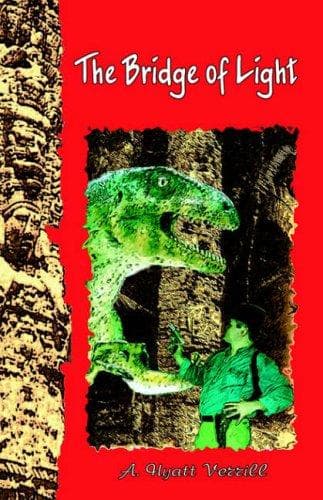
The bridge of lightVerrill, A. Hyatt (Alpheus Hyatt)
Science
The bridge of light
Verrill, A. Hyatt (Alpheus Hyatt)
Adventure stories; Central America -- Fiction; Mayas -- Fiction; Science fiction
As we were doing this--for Itza was more expert at such matters than I
was--she touched my arm and pointed silently to where an unsuspicious
deer had stepped from the jungle and stood looking at us curiously.
That night we dined on broiled venison, and spent the evening
“haricotting” the rest of the meat over a smoky fire. We now had
plenty of food to last us for several days, even if no other game was
obtainable and I had no further fear of going hungry for some time to
come. The sun was just topping the mountains when we set off the next
morning, following the course of the stream, happy and light-hearted.
By noonday, when we stopped again to rest and eat, the brook had
widened to a fair-sized river and, remembering the vision or whatever
it was, that I had seen in the sorcerer’s smoke, I looked about for
material with which to construct a raft or boat of some sort.
Then for the first time, I realized that I was unconsciously assuming
that I actually _had_ looked into the future, or at least had, by some
mysterious means, been enabled to view the route we were following.
Nonsense! I said to myself. How could I have seen a place I had never
visited? By some form of hypnosis or auto-suggestion Nohul Voh might
have caused me to _think_ I saw the valley near the cliff with the
great idol. I _had_ seen that before. But I had surely never been here
by this broad stream. Yet there was the symbol on the rock by the pool.
There was the stream. Try as I might to argue against it, I felt in my
heart and innermost mind that everything would eventuate precisely as I
had seemed to see it back in Mictolan. And at any rate, it would be far
easier and quicker to travel down river by boat or raft than to follow
the winding course of the stream afoot.
In the tropics, it is usually a simple matter to make some sort of
a craft that is buoyant, easily handled and capable of supporting
considerable weight in fairly calm water. There are always bamboos or
the cork-like Balsa trees within easy reach when in jungle country, and
where there are lakes or back-waters, there are the hollow reeds that,
tied into bundles and lashed together, may be used to construct those
light, seaworthy but strange crafts known as “balsas” by the Indians,
who use them exclusively to navigate the waters of Lake Titicaca. And
here, close to the stream, were bamboos, cork-like balsa[4] trees and
plenty of reeds. Itza fell to with a will and worked like a beaver.
Her endurance and strength always surprised me. She did not give the
impression of being a particularly strong woman, but the soft curves
and contours of her body and limbs covered muscles that were almost
equal to my own, and she possessed the remarkable endurance of her
race. And when it came to performing any task that called for primitive
methods or native skill, she was immeasurably superior to me, despite
the fact that I always prided myself upon my knowledge and experience
of woodcraft.
Public-domain text, read in full here on John Shaqi.
Reviews
Reviews
No reviews yet
Be the first to share your thoughts on this work.
Elsewhere in the archive
Join the Discussion
Join the discussion
Sign in to leave a comment or review.
Sign InorCreate an account