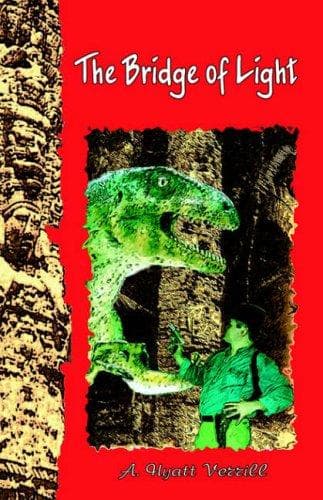
The bridge of lightVerrill, A. Hyatt (Alpheus Hyatt)
Science
The bridge of light
Verrill, A. Hyatt (Alpheus Hyatt)
Adventure stories; Central America -- Fiction; Mayas -- Fiction; Science fiction
That settled it. I had no further fears. In fact, as the Indians drew
near they were far more afraid of us than we had been of them. I
shouted to them in Zutugil, but that appeared only to scare them the
more. Then I tried Spanish, and with shouts of delight they replied in
the same tongue. They were friendly, half-civilized, simple, harmless
people, and ten minutes later we were in the village, objects of the
most intense curiosity on the part of the villagers. But when, by
chance, they caught a glimpse of the tattooed symbol on my chest,
their curiosity changed instantly to wonder and adoration. They might
be Spanish-speaking, degenerate, semi-Christianized, half-civilized
members of their race, but they still recognized the mark of the
ancient Mayan priest-kings and revered those who bore it. At this
juncture, Itza bent towards me and whispered a question that brought
roars of laughter from my lips.
“Are these people of your race, Itzimin?” she asked.
To me there was something extremely ludicrous in her query, in her
mistaking members of her own race for Anglo Saxons. But after all, why
not? They were no more like the people of Mictolan than--well, I was
about to say than like me, but honestly, of the two, I verily believe
that, being a civilized man “gone native” as one might say, I looked
far more like their kinsman than any man in Mictolan.
For a moment Itza looked hurt at my merriment over her quite natural
and innocent question, but when I had explained, she regarded it as a
good joke and laughed gaily herself. And as the Indians felt that there
must be something funny, and that it would be discourtesy to their
distinguished guest not to show appreciation of it, they, too, burst
into peals and roars of laughter.
* * * * *
THEY were good-natured, simple folk, and in reply to my questions,
informed me there was a white man in a village three days’ walk to
the south. He was, they added, a Padre, though why I, a member of the
exalted, almost sacred Titul Zius clan, should want to find a white
man or civilization was quite incomprehensible to them. That I was
within three days of a village where there was a priest was not so
surprising to me as it might seem. It is a remote Indian village indeed
that is too far away to have its Padre, and that we had come far and
deviously from the valley of Mictolan I knew. The hidden city might be
two hundred, three hundred miles distant, and in that wilderness of
unexplored mountain ranges such a place as Mictolan might well remain
hidden forever, even though within one hundred miles of settlements and
even of railways.
“And how is this village called, wherein dwells the Padre?” I asked my
informant, who appeared to be the Cacique of the village by the lake.
“It is called the village of Xibaltango, my lord,” he replied.
Public-domain text, read in full here on John Shaqi.
Reviews
Reviews
No reviews yet
Be the first to share your thoughts on this work.
Elsewhere in the archive
Join the Discussion
Join the discussion
Sign in to leave a comment or review.
Sign InorCreate an account